

Key Takeaways
- Brent crude declined nearly 4% to approximately $100 per barrel following news of a US-proposed 15-point ceasefire framework for Iran
- WTI crude decreased 4% to $88.70 per barrel, with UK natural gas prices sliding 8%
- President Trump confirmed the US is “in negotiations right now” with Iran, though Iranian officials deny any dialogue is underway
- Israeli military operations in Tehran continued despite diplomatic overtures from Washington
- International equity markets surged on the news, with the FTSE 100, DAX, and CAC 40 all posting significant gains
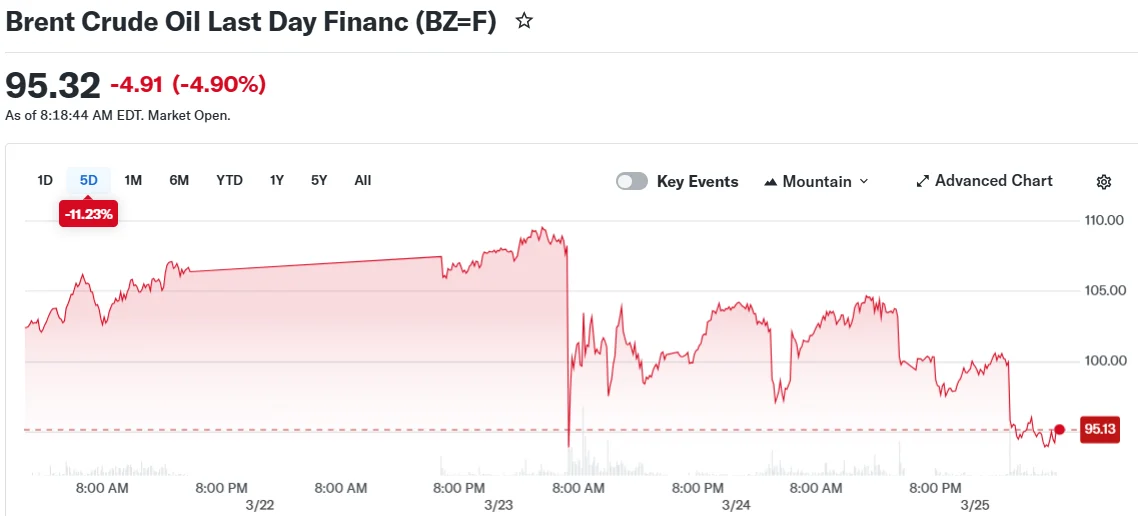
As of Wednesday morning, Brent crude was changing hands at approximately $100.41 per barrel, marking a decline of nearly 4%, while WTI crude settled at $88.70.
Energy markets experienced a significant pullback on Wednesday following revelations that the Trump administration had transmitted a 15-point diplomatic framework to Iran focused on resolving the ongoing Middle East tensions. The document was conveyed through Pakistani diplomatic channels, with Pakistan extending an invitation to facilitate renewed discussions between the United States and Iran.
President Trump stated the US is currently “in negotiations right now” with Iran, indicating that Tehran was “talking sense.” He had previously characterized Monday’s discussions as “productive.”
Iranian authorities, conversely, completely rejected claims that any negotiations were underway — asserting that American officials were merely negotiating among themselves.
JUST IN: Iran responds on the Negotiations allegations:
"You have reached a stage where you are negotiating with yourselves"
“Do not call your defeat an agreement.”
“There will be no news of your investments in the region, and you will not see the former price of energy and… pic.twitter.com/ufZ0GchFjF
— Sulaiman Ahmed (@ShaykhSulaiman) March 25, 2026
This conflicting narrative established the framework for a turbulent trading session. Market participants showed clear optimism regarding potential de-escalation while remaining cognizant that circumstances could rapidly deteriorate.
Brent crude touched an intraday low of $97.30 before experiencing a modest rebound. WTI crude similarly plunged, decreasing 4% to $88.70 per barrel. UK natural gas valuations simultaneously declined 8%.
Equity Markets Surge Following Energy Price Decline
The reduction in energy valuations provided momentum to global equity indexes. London’s FTSE 100 advanced over 1%, climbing 103 points to reach 10,068. Germany’s DAX jumped 1.6% while France’s CAC 40 rose 1.5%. Asian trading sessions had already recorded substantial overnight gains.
Matt Britzman, senior equity analyst at Hargreaves Lansdown, noted: “Oil prices have retreated on these developments, providing some respite to equities that had been pressured by concerns over inflation and the subsequent implications for interest rates.”
Richard Hunter, head of markets at interactive investor, adopted a more measured stance, emphasizing that the FTSE 100 remains approximately 8% beneath its all-time peak recorded in late February.
Strait of Hormuz Still Central to Market Stability
The primary point of tension has centered on the Strait of Hormuz, the vital maritime passage that has been essentially closed due to Iranian threats against oil tankers. This disruption has propelled prices substantially higher in recent weeks.
Analysts at ING observed: “Despite the initial market relief, uncertainty remains high. Overall, volatility remains elevated and a geopolitical risk premium persists.”
Meanwhile, concurrent with diplomatic messaging, Israeli forces conducted strikes on Tehran Wednesday — introducing additional complexity to an already convoluted scenario.
The US military is simultaneously positioning to deploy a minimum of 1,000 additional troops to the region, supplementing the 50,000 personnel already stationed there.
Britzman was unambiguous about the requirements for sustained price reductions: “Social media posts and press conferences can only go so far, and it will likely take a full reopening of the Strait of Hormuz to drive any meaningful and sustained move lower from here.”
Pricing continues to remain considerably elevated compared to pre-conflict benchmarks, and the Strait of Hormuz has yet to reopen.
