


Key Highlights
- Ethereum currently sits at $2,160.46, marking a 1.95% daily decline
- The asset holds above its 50-day moving average ($2,100.87) but remains distant from the 200-day level at $3,204.32
- March witnessed the debut of BlackRock’s staked Ethereum ETF (ETHB), enhancing institutional participation
- Spot Ethereum ETFs accumulated approximately $385 million in net inflows during a six-consecutive-day period in March
- Open interest in ETH derivatives surged roughly 8–9% within 24 hours, exceeding $30 billion
Ethereum has settled at $2,160.46, reflecting a $43.01 decline for the session—a 1.95% downturn. Trading commenced at $2,203.46, with intraday boundaries spanning from $2,143.22 to $2,233.69.
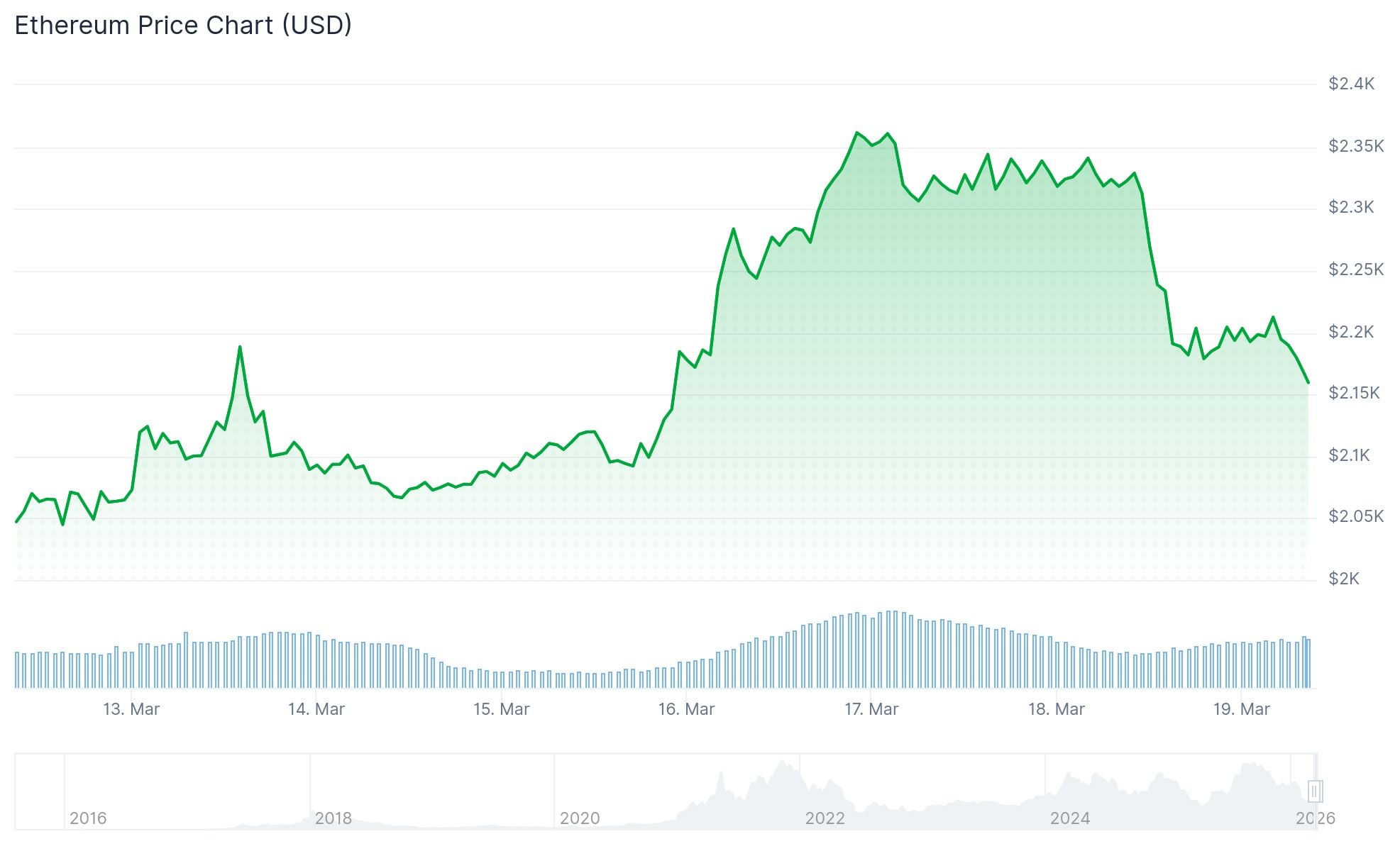
This retreat arrives after several weeks of upward momentum from the $2,000 threshold. Despite today’s pullback, ETH maintains approximately 8–10% gains compared to early-month valuations. Trading volume registers around 71 million dollars, significantly below the typical 343 million dollar average, suggesting standard profit realization rather than distressed liquidation.
Institutional Capital and ETF Dynamics
Among March’s most significant catalysts was BlackRock’s introduction of the iShares Staked Ethereum Trust (ETHB) on Nasdaq. This product distinguishes itself from previous spot ETH offerings by incorporating staking rewards directly into the fund structure, presenting a compelling proposition for institutions seeking exposure to Ethereum’s yield-generating capabilities.
🚀 Crypto ETF Flows — Bitcoin News
🔹 $BTC: 7D streak | $1.16B total | $199M daily
🔹 $ETH: 6D streak | $138M inflow | $13.75B AUM
🔹 $SOL +$17.8M | XRP +$4.6M
🔹BlackRock IBIT, ETHA lead flows#CryptoSignals #ETFTrading pic.twitter.com/icb14JeOjN— Boominance (@boominance) March 18, 2026
Spot Ethereum exchange-traded funds have demonstrated consistent capital attraction. Individual trading sessions recorded net inflows approaching 12.6 million dollars, with dominant products capturing over 10 million dollars. Throughout a six-day window in March, aggregate inflows into ETH-based funds reached approximately 385 million dollars.
This institutional capital has provided crucial price stability during moments of speculative liquidation.
Chart Structure and Critical Thresholds
Examining daily timeframe analysis, Ethereum maintains position above its 50-day moving average at $2,100.87. This technical indicator has served as reliable support during recent corrections.
My opinion on #Ethereum is the same.
We won't see 1500 until we see 2900.
3350$ ☑️
1850$ ☑️
2950$⌛️
1500$ ⌛️
6100$ ⌛️(September – December) #ETH $ETH pic.twitter.com/kYBBfUS7Ql— Celal Kucuker (@CelalKucuker) March 18, 2026
The 200-day moving average positioned at $3,204.32 remains considerably elevated relative to current valuation, indicating the extended trend has yet to fully restore itself.
Critical support zones emerge at $2,000–$2,060. Beneath this foundation, $1,800 represents the boundary that has characterized the lower spectrum of prevailing range-bound behavior. Overhead, resistance concentrates within $2,235–$2,380, while a substantial breakout threshold appears near $2,500.
$ETH is facing resistance around the $2,400 level.
I think a pump above this zone could happen, but now the max pain is to the downside for Ethereum. pic.twitter.com/DRXixUGjr1
— Ted (@TedPillows) March 18, 2026
Ethereum derivatives open interest expanded approximately 8–9% during a single 24-hour window, propelling total exposure beyond $30 billion across primary platforms including Binance, Bybit, and OKX. Market structure specialists observe that escalating open interest concurrent with price appreciation can amplify momentum in either trajectory.
ETH continues encountering difficulty establishing sustained acceptance beyond the $2,300–$2,400 corridor. Present market architecture reflects consolidation behavior, characterized by compressed price action and subdued realized volatility, potentially signaling an imminent directional expansion.
Ethereum’s aggregate market capitalization approximates $260.76 billion, securing its position as the second-largest digital asset by valuation.
