


Key Takeaways
- US equity futures advanced Tuesday following reports Trump may conclude Iran operations without requiring Strait of Hormuz reopening
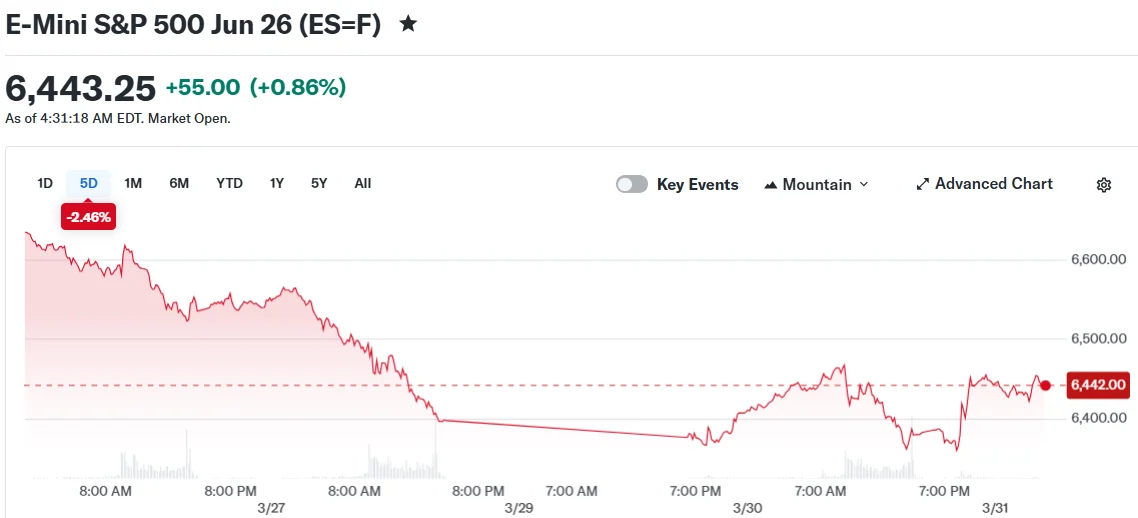
- Dow futures advanced 1%, S&P 500 futures climbed 0.9%, Nasdaq 100 futures increased 0.8%
- Major indices heading toward their weakest quarterly performance since 2022
- Crude oil prices held above $100 per barrel despite diplomatic developments
- Markets anticipate March consumer confidence figures and February jobs opening statistics
Equity futures in the United States gained momentum Tuesday morning following reports indicating President Trump’s potential readiness to conclude military operations in Iran without demanding complete access through the Strait of Hormuz.
Contracts linked to the Dow Jones Industrial Average climbed approximately 459 points, representing a 1% increase. S&P 500 futures advanced 0.9% while Nasdaq 100 futures registered a 0.8% gain.
The upward momentum followed a late Monday report from The Wall Street Journal revealing that Trump and his administration had determined that operations to fully reopen the Strait of Hormuz would prolong the military engagement beyond their desired timeline of four to six weeks.
BREAKING: President Trump is willing to end the Iran War even if the Strait of Hormuz remains closed, per WSJ.
Details include:
1. Trump and his aides assessed that a mission to reopen Hormuz would push the conflict beyond his timeline 4-6 weeks
2. Trump believes the US should…
— The Kobeissi Letter (@KobeissiLetter) March 31, 2026
In a Tuesday morning post on Truth Social, Trump appeared to suggest a winding down of operations. “Iran has been, essentially, decimated,” the president stated. “The hard part is done. Go get your own oil!”
Henry Allen, a macro strategist at Deutsche Bank, noted that the Wall Street Journal reporting had “raised hopes that the current phase of the conflict will wind down soon,” further observing that “the market tone has become decidedly more positive overnight.”
Tuesday marks the conclusion of first-quarter trading. The three primary indices are tracking toward their poorest quarterly results since 2022, based on Dow Jones Market Data.
All three benchmarks declined Monday, surrendering earlier advances as market participants grew concerned about the continuing Middle East situation.
Market sentiment had deteriorated significantly before Tuesday’s session. The CBOE Volatility Index surpassed 30 on Monday, indicating elevated investor concern.
Crude Prices Maintain Elevation Despite Progress Signals
Oil prices sustained elevated levels despite improved diplomatic indicators. West Texas Intermediate crude settled above $100 per barrel for the first time since 2022. Tuesday morning saw WTI futures add another 0.4% to reach $103.28 per barrel. Brent crude held steady at $107.38.
Equities have found it challenging to maintain rallies in recent sessions when petroleum prices remain elevated, continuing to worry market participants.
Gold futures increased 0.5% to $4,581 per ounce during early trading hours. The benchmark 10-year Treasury yield decreased one basis point to 4.33%. The dollar remained unchanged against a basket of global currencies.
Messaging from the administration has shown inconsistency. While certain officials have highlighted diplomatic advancement, Trump separately raised the possibility that the United States might move to take control of Iranian oil resources.
Key Economic Releases Expected Tuesday
Market participants await important economic data releases scheduled for Tuesday afternoon. Both the March consumer confidence index and the February Job Openings and Labor Turnover Survey are set for release. These indicators should provide better insight into the current state of the American economy as the second quarter begins.
The joint US-Israeli military operations against Iran reached their fifth week as of Tuesday.
