

Key Takeaways
- Bittensor maintains a maximum supply of 21 million TAO tokens with Bitcoin-style halving events, the first of which reduced daily issuance from 7,200 to 3,600 TAO in December 2025.
- The project launched without a premine or initial coin offering, distinguishing it from many AI-focused cryptocurrency projects.
- With a fully diluted valuation exceeding $6.6 billion, TAO’s market cap reflects substantial expectations for future performance.
- Bittensor operates through specialized subnets functioning as distinct AI service marketplaces, though questions persist about how effectively TAO captures economic value.
- Token issuance persists post-halving, creating continued supply pressure despite the reduced emission rate.
Bittensor represents a complex departure from typical AI cryptocurrency projects. Rather than a single application, it functions as an infrastructure layer comprising multiple subnets, each operating distinct AI service marketplaces spanning inference engines, storage solutions, and data operations. TAO serves as the native asset binding this ecosystem together.
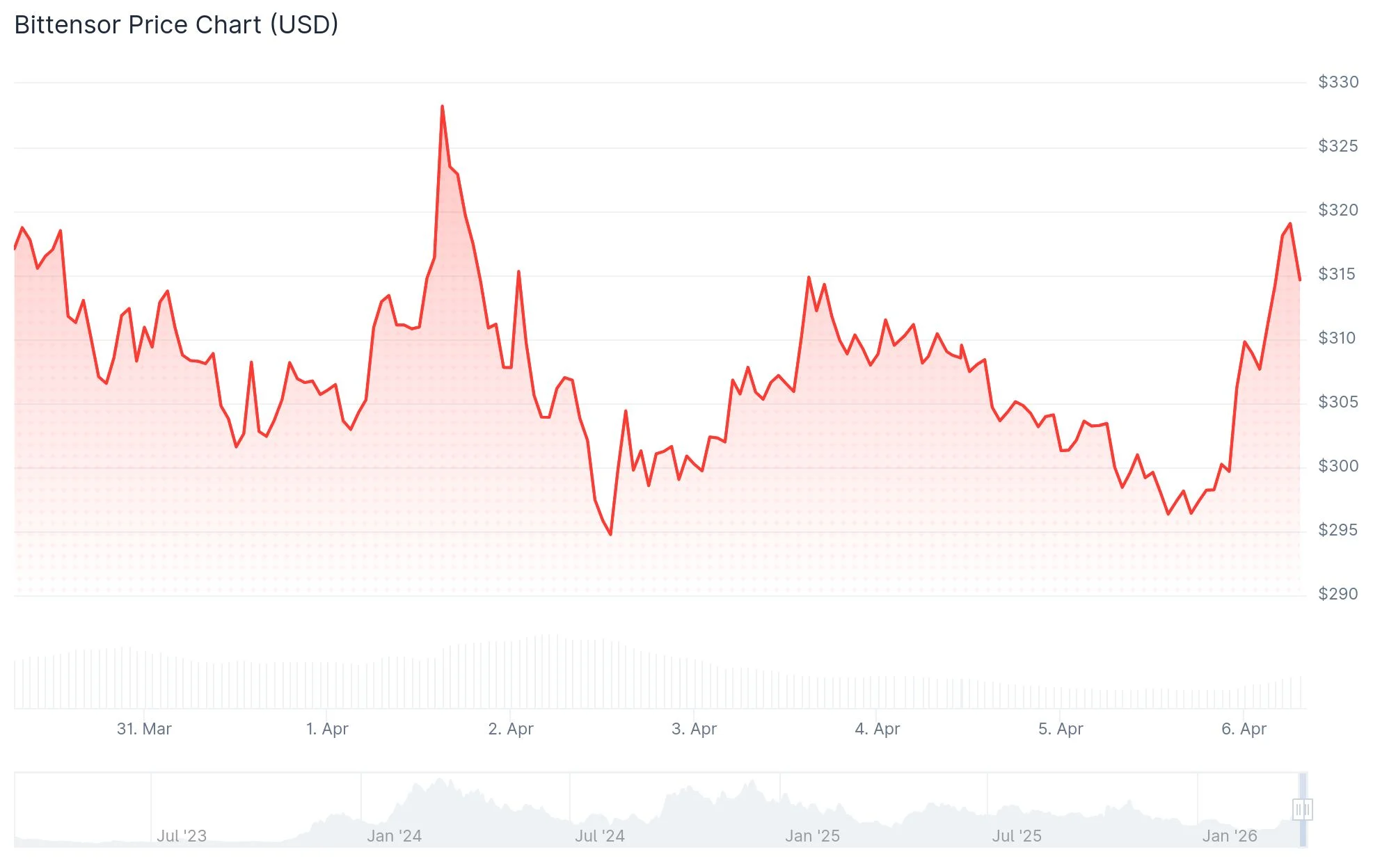
The network has cultivated significant interest from crypto and AI communities alike. However, an innovative technical architecture doesn’t automatically translate into compelling token economics.
TAO’s supply structure differentiates it markedly from competing crypto AI ventures. The network enforces a 21 million token ceiling, mirroring Bitcoin’s scarcity model. According to the Opentensor Foundation, the project distributed tokens without any premine allocation or initial coin offering, eliminating common early-stage centralization concerns.
Bittensor implements scheduled supply halvings similar to Bitcoin. The inaugural halving occurred mid-December 2025, slashing daily token emissions from approximately 7,200 TAO to 3,600 TAO, as documented by Grayscale.
Controlled Supply Doesn’t Eliminate Dilution
Despite the reduced emission schedule, fresh tokens continue entering circulation daily. Current holders experience ongoing dilution pressure, albeit at a decelerated rate compared to pre-halving levels.
CoinGecko reports TAO’s fully diluted valuation surpassing $6.6 billion. Investors frequently focus exclusively on circulating supply metrics while overlooking total supply implications. For TAO, understanding the complete token distribution timeline remains critical.
A fixed maximum supply establishes an upper boundary but doesn’t inherently validate current pricing. It simply defines the eventual endpoint.
The Value Capture Dilemma
This represents the fundamental challenge facing Bittensor investors. While the network may successfully establish thriving AI marketplaces across its subnet architecture, establishing that TAO effectively captures economic value from these activities remains unproven.
TAO serves staking and network incentive functions, providing clear utility within the ecosystem. However, internal utility differs substantially from generating external demand driven by fundamental value creation rather than speculative positioning.
Numerous blockchain networks demonstrate this disconnect—network activity expands while native token prices remain tethered primarily to market sentiment. Bittensor confronts this identical structural challenge.
The subnet architecture introduces additional complexity. This technical sophistication creates barriers for typical investors attempting to evaluate genuine network growth versus emissions-inflated activity metrics.
Grayscale highlighted how token emissions can artificially inflate usage statistics, creating misleading impressions of adoption and engagement.
TAO’s inaugural halving event in December 2025 marked a significant milestone, cutting daily token distribution by fifty percent.
Bottom Line
Among cryptocurrency AI projects, Bittensor stands out for technical ambition and distribution fairness. The tokenomics demonstrate greater discipline than industry norms, the launch avoided concentrated early allocations, and the subnet framework presents genuine innovation. Yet TAO already commands a multi-billion dollar valuation while facing persistent dilution and unresolved questions regarding how effectively the token captures value generated within its own ecosystem.
