

Key Takeaways
- Crude markets experienced dramatic fluctuations Monday amid emerging ceasefire negotiations between Washington and Tehran
- Brent temporarily surged past the $110 mark before retreating on news of a possible 45-day truce agreement
- President Trump issued a Tuesday ultimatum, warning of attacks on Iranian power facilities and transportation infrastructure if the critical waterway remains closed
- Tehran’s Revolutionary Guards cautioned they would escalate strikes against American economic targets if attacks on civilian sites persist
- OPEC+ members approved a modest production boost of 206,000 bpd for May, though implementation remains doubtful for many producers
Oil prices experienced significant volatility Monday as market participants balanced the possibility of renewed American military action against Iran with emerging diplomatic breakthrough signals.
Brent crude momentarily exceeded the $110 per barrel threshold before retreating. During Asian trading hours, it stabilized near $109.80, representing a 0.7% increase. Meanwhile, West Texas Intermediate remained relatively unchanged at $111.62.
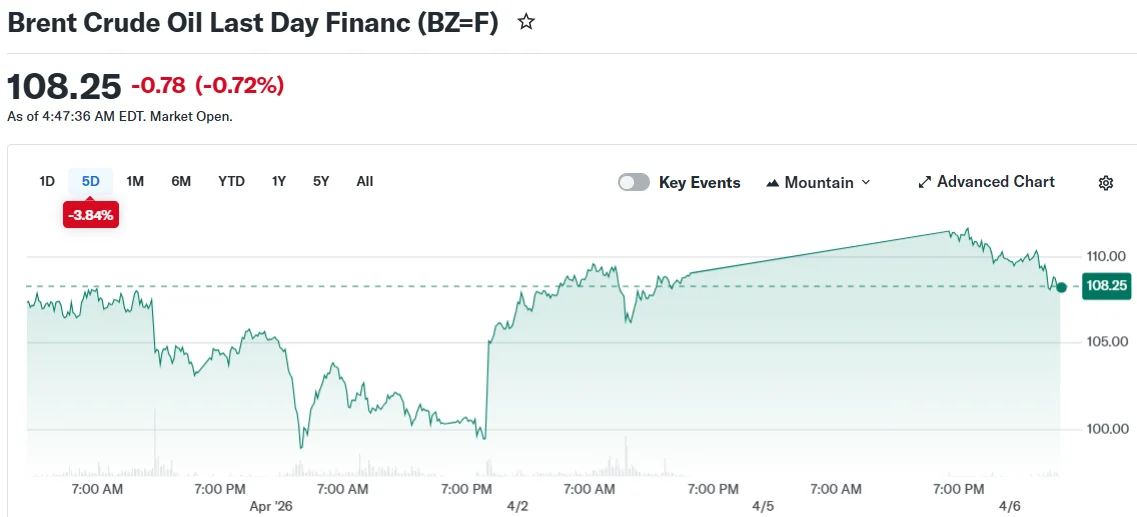
The erratic price movements demonstrate how closely energy markets are monitoring each new development in the escalating U.S.-Iran confrontation, which commenced when American and Israeli military forces conducted operations against Iranian targets on February 28.
Prior to the outbreak of hostilities, Brent was valued at approximately $70 per barrel. The benchmark crossed the $100 threshold last week following Trump’s warning of devastating military strikes.
Over the weekend, Trump published an aggressive statement on Truth Social, threatening to target Iranian power generation facilities and critical bridge infrastructure unless the strategic Strait of Hormuz waterway was reopened by Tuesday evening U.S. Eastern time.
In his characteristic style, Trump declared: “Tuesday will be Power Plant Day, and Bridge Day… Open the Fuckin’ Strait, you crazy bastards, or you’ll be living in Hell.”
He subsequently confirmed the specific timeframe: “Tuesday, 8:00 P.M. Eastern Time.”
🚨 President Trump: "Tuesday will be power plant day"
US futures -0.54%$SPY $QQQ #Iran pic.twitter.com/ylWFfvAp6c
— Crypto Seth (@seth_fin) April 5, 2026
During a Fox News interview, Trump indicated there was a “good chance” negotiations could conclude successfully Monday. He also suggested the alternative of “blowing everything up and taking over the oil” should diplomatic efforts collapse.
Iranian military leadership dismissed the ultimatum outright. General Ali Abdollahi Aliabadi, a senior commander, characterized the deadline as “helpless, nervous, unbalanced and stupid” and warned that “the gates of hell will open” for Trump.
Diplomatic Breakthrough Possible
According to reports from Axios, American officials, Iranian representatives, and regional intermediaries are negotiating a potential 45-day cessation of hostilities that could pave the way for a permanent resolution. Reuters separately confirmed that both parties had received a proposed framework that might be implemented as soon as Monday.
The White House declined to comment when contacted. BBC News indicated it could not independently confirm the Axios reporting.
Iran maintained its military operations throughout the weekend, taking credit for attacks on petrochemical facilities across Kuwait, Bahrain, and the United Arab Emirates. The Revolutionary Guards issued a fresh warning Monday that strikes on American economic assets would intensify if Iranian civilian infrastructure continues to be targeted.
OPEC+ Production Increase Largely Symbolic
OPEC+ members reached consensus Sunday on expanding crude production by 206,000 barrels daily beginning in May. Nonetheless, energy analysts characterize the increase as mostly theoretical. Multiple major producers lack the capacity to boost output due to conflict-related disruptions.
The Strait of Hormuz, a critical chokepoint responsible for roughly 20% of global energy transport, has remained obstructed for several weeks. The blockade has driven worldwide energy costs higher and intensified inflation worries in nations reliant on Middle Eastern petroleum supplies.
Wood Mackenzie consultant Sushant Gupta predicted continued price instability, with movements dictated by each emerging development from the ongoing conflict.
