


Key Takeaways
- Major US equity indexes retreated Thursday amid escalating Middle East tensions that drove oil markets sharply higher
- Brent crude soared to $119 per barrel following military strikes on energy infrastructure by Israel and Iran
- Bitcoin slipped under the $70,000 threshold, pressured by broader market weakness and Federal Reserve policy signals
- The Federal Reserve indicated zero rate cuts possible in 2026, with some market participants now anticipating potential rate increases
- Micron and Alibaba experienced share price declines following earnings releases that sparked concerns about AI investment returns
Equity markets across the United States experienced significant declines Thursday following military actions between Israel and Iran targeting petroleum and natural gas infrastructure in the Persian Gulf region, propelling crude oil prices substantially higher and unsettling investors already grappling with mounting inflationary pressures.
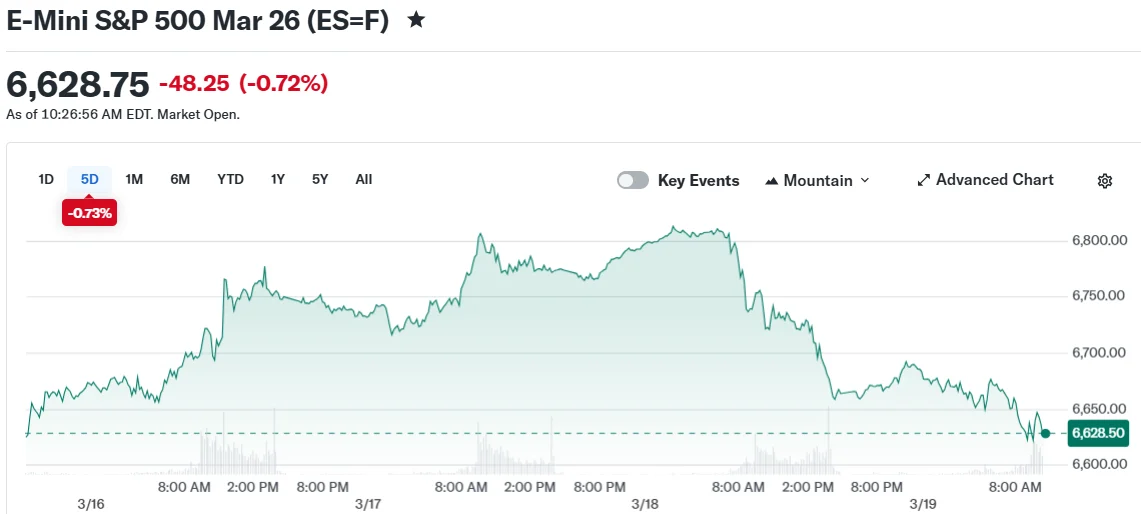
The Dow Jones Industrial Average plummeted approximately 300 points at market open, representing a decline of roughly 0.7%. The S&P 500 retreated 0.9% while the Nasdaq Composite suffered a 1.3% loss before both benchmarks recovered portions of their losses during the trading session.
Brent crude futures skyrocketed as much as 10%, touching $119 per barrel before stabilizing near $112. West Texas Intermediate crude experienced a more moderate climb to approximately $96 per barrel, expanding the differential between the two oil benchmarks to its widest margin in several years.
This is absolutely insane:
The world is quite literally facing what appears to be the largest energy crisis in history.
US crude oil futures are now trading at a $20+/barrel DISCOUNT to Brent, also one of the largest on record.
As the US increases production and taps into…
— The Kobeissi Letter (@KobeissiLetter) March 19, 2026
Israel launched strikes targeting Iran’s South Pars gas field infrastructure. In retaliation, Iran executed attacks on energy facilities located in Qatar and Saudi Arabia. Market analysts characterized the mutual strikes as representing a dangerous new escalation in the ongoing conflict.
David Rosenberg from Rosenberg Research cautioned that the damage inflicted on critical energy infrastructure suggests oil prices are unlikely to retreat to pre-conflict levels swiftly, even following an eventual resolution to hostilities.
Federal Reserve Policy and Market Expectations
The Federal Reserve maintained its current interest rate position at its most recent policy meeting and communicated the possibility of just one rate reduction this year. Fed Chair Jerome Powell’s remarks were interpreted by market participants as taking a hawkish stance, leading traders to price in zero rate cuts for 2026. Speculation about a potential near-term rate increase has also emerged.
SUMMARY OF FED DECISION (3/18/2026):
1. Fed halts rate cuts for the second straight meeting
2. Fed projects one rate cut in 2026, one in 2027
3. Fed 2026 PCE inflation forecast revised higher to 2.7%
4. Fed says implications of Middle East developments are "uncertain"
5. Fed…
— The Kobeissi Letter (@KobeissiLetter) March 18, 2026
The central bank simultaneously adjusted its inflation projections upward, compounding worries that the spike in oil prices could further exacerbate the inflationary environment.
Weekly initial jobless claims registered at 205,000, declining from the previous week’s figure, providing one of the few bright spots in an otherwise challenging trading day.
Bitcoin descended below the $70,000 level on Thursday. The cryptocurrency’s decline coincided with the broader equity market retreat and the Federal Reserve’s hawkish rate policy outlook. XRP similarly experienced downward movement.
Corporate Earnings and Stock Movement
Micron shares declined in premarket trading despite delivering robust earnings results. Market participants concentrated on the semiconductor company’s substantial AI infrastructure spending plans, raising questions about the timeline for achieving returns on those capital investments.
Alibaba’s stock price also tumbled after the e-commerce giant disclosed a 67% plunge in quarterly profits. The disappointing financial performance underscored mounting pressure on the company to demonstrate tangible returns from its artificial intelligence initiatives.
Asian equity markets declined overnight following news of the Middle East escalation. US short-duration Treasury yields climbed as bond market selling intensified.
The Philadelphia Fed Manufacturing Index was scheduled for release later Thursday, with investors monitoring for additional indications of economic deterioration.
As of mid-morning trading in New York, the Dow Jones Industrial Average was lower by 283 points, the S&P 500 had declined 0.5%, and the Nasdaq Composite was down 0.6%.
