


Key Takeaways
- Two-week ceasefire agreement reached between Washington and Tehran, clearing the Strait of Hormuz
- Futures markets exploded higher with Dow gaining 1,300+ points and Nasdaq 100 surging 3.5%
- Crude oil collapsed with Brent down nearly 15% and WTI plummeting approximately 17%
- Cryptocurrency markets rallied as Bitcoin broke through $70,000 alongside gains in Ethereum and XRP
- Precious metals climbed with gold advancing 3.3% on reduced inflation concerns
In a late Tuesday announcement, President Trump revealed that Washington would halt military operations against Iran for a fourteen-day period contingent upon Tehran reopening the critical Strait of Hormuz. Iran’s top diplomat, Foreign Minister Seyed Abbas Araghchi, quickly validated the agreement, confirming that commercial vessels would resume safe transit through the strategic waterway once hostilities ceased.
Trump Halts Iran Strikes for Two Weeks Amid Ceasefire Push
U.S. President Donald Trump said on Truth Social that, following discussions with Pakistani Prime Minister Shehbaz Sharif and Field Marshal Asim Munir, and conditional upon Iran’s agreement to the immediate, full, and… pic.twitter.com/npInV48tUR
— Wu Blockchain (@WuBlockchain) April 7, 2026
Shortly past midnight, Trump took to Truth Social to elaborate that American forces would assist in coordinating vessel traffic through the congested strait. Tehran’s Supreme National Security Council officially ratified the ceasefire conditions.
The announcement set off a powerful chain reaction throughout worldwide financial markets. Capital that had been parked in defensive positions rapidly rotated back into higher-risk investments.
Futures tied to the Dow Jones Industrial Average rocketed 1,306 points higher, representing a 2.8% advance. The S&P 500 futures contract climbed 2.8%. Nasdaq 100 futures outperformed with a 3.5% surge, pacing the equity rally.
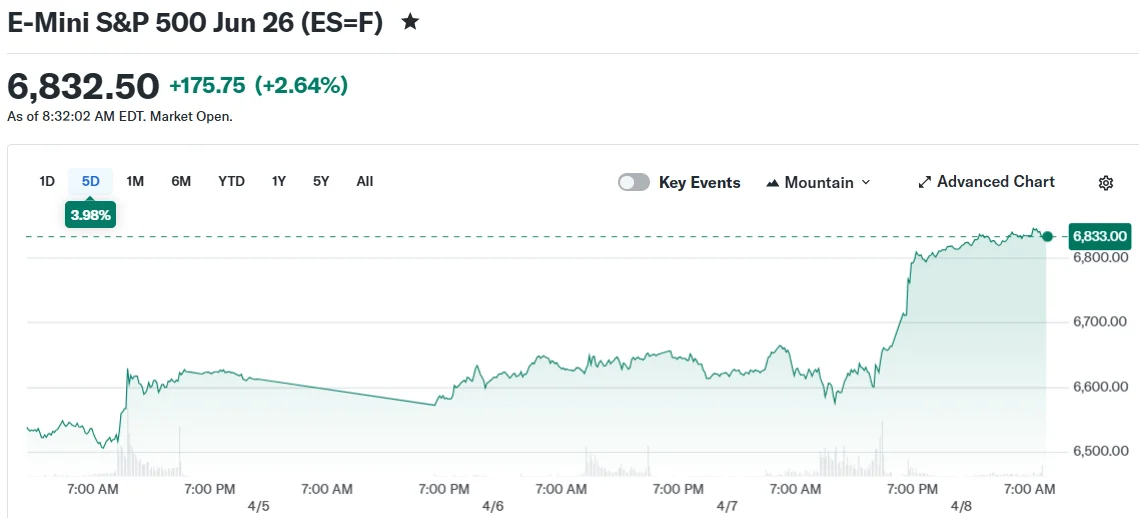
The previous trading session had seen all three benchmark indices drift without clear direction as market participants digested Trump’s aggressive rhetoric regarding potential strikes on Iranian critical infrastructure, including transportation networks and energy facilities.
Energy Markets Experience Dramatic Selloff
Crude oil experienced the most dramatic price movement following the ceasefire announcement. International benchmark Brent crude futures collapsed nearly 15%, settling around $94.69 per barrel. The domestic WTI contract tumbled approximately 17% to trade near $96.22 per barrel.
The Strait of Hormuz represents a critical chokepoint just 21 miles across at its narrowest point, facilitating the transit of roughly one-fifth of global petroleum supplies. News of its imminent reopening eliminated substantial geopolitical risk premiums that had inflated energy prices.
The collapse in petroleum prices immediately altered Federal Reserve policy expectations. Declining energy costs directly suppress inflationary pressures, potentially creating additional flexibility for the central bank to implement interest rate reductions.
Market participants awaited Wednesday’s scheduled publication of minutes from the Federal Reserve’s March policy meeting, anticipating insights into how committee members assessed the economic ramifications of Middle Eastern tensions.
Digital Assets and Precious Metals Advance
Bitcoin pushed above the $70,000 threshold. Alternative cryptocurrencies including Ethereum and XRP posted substantial gains as digital asset markets participated in the widespread risk appetite.
Gold futures surged 3.3% to reach $4,840 per ounce. The yellow metal typically benefits from lower interest rate expectations, becoming more competitive relative to yield-bearing instruments when bond returns decline.
The U.S. dollar index retreated 1% versus a basket of major global currencies. Meanwhile, the benchmark 10-year Treasury note yield contracted 6 basis points to settle at 4.24%.
Aviation Sector Under Scrutiny
Delta Air Lines was set to unveil quarterly financial results ahead of Wednesday’s opening bell. Market analysts focused intently on the carrier following widespread flight cancellations and elevated jet fuel expenditures throughout the regional conflict.
Robert Edwards, chief investment officer at Edwards Asset Management, characterized the ceasefire as a pivotal sentiment catalyst. “Just the scent of thawing tensions is enough for forward-looking stocks to keep climbing the wall of worry,” he stated.
Iran’s Foreign Minister validated on X that commercial navigation through the Strait of Hormuz would proceed “via coordination with Iran’s Armed Forces” throughout the two-week ceasefire window.
