


TLDR
- Brent futures surged past $96 per barrel, with WTI approaching $99, following Saudi confirmation that recent attacks reduced output capacity by 600,000 barrels daily
- Despite Friday’s gains, crude is heading toward its steepest weekly decline since June, losing over 10% after Tuesday’s US-Iran ceasefire announcement
- Tehran resumed its blockade of tanker movement through the Strait of Hormuz following Israeli military operations in Lebanon
- Diplomatic discussions between Washington and Tehran scheduled for Islamabad this weekend face uncertainty after Iran disputed delegation arrival
- Major Asian consumers including Japan, China, and India are releasing strategic petroleum reserves to offset supply constraints
Crude futures extended their recovery for a consecutive session Friday, yet remained positioned for their most significant weekly decline in months as Middle Eastern supply disruptions continued to unsettle global energy markets.
Brent benchmark futures advanced beyond $96 per barrel, while West Texas Intermediate approached $99. Both benchmarks registered approximately 1% gains during Asian market hours Friday.
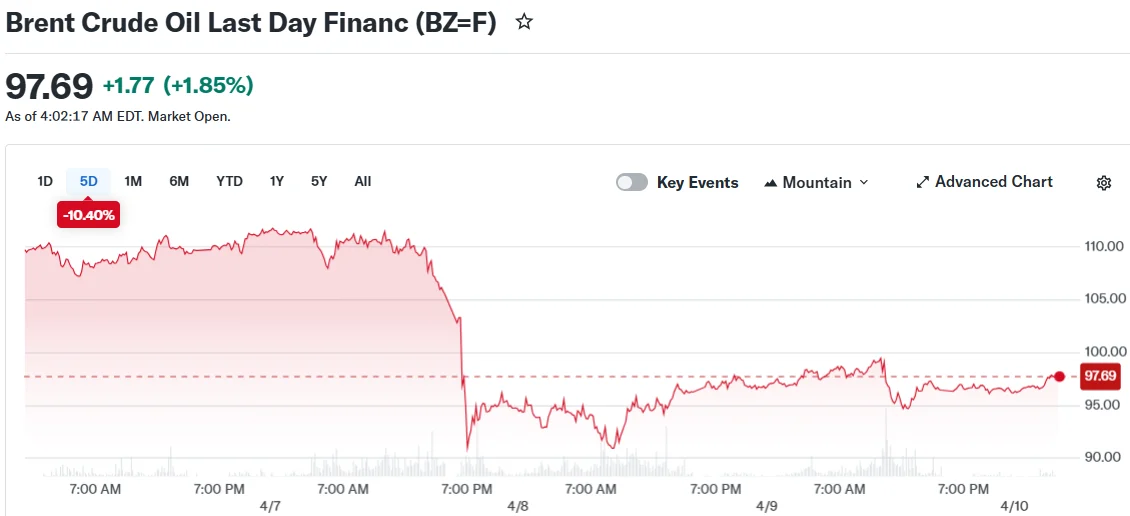
Notwithstanding these intraday advances, Brent remains positioned to lose more than 11% across the trading week. WTI has posted comparable weekly losses.
The substantial weekly retreat followed Tuesday’s ceasefire declaration between Washington and Tehran. Initial market reaction pushed prices sharply lower on expectations that crude shipments would normalize.
However, geopolitical complexities rapidly emerged. Just hours after the truce announcement, Israeli forces conducted military operations in Lebanon, asserting that its confrontation with Hezbollah fell outside ceasefire parameters.
Tehran’s immediate response involved reimposing its blockade on commercial tanker movement through the Strait of Hormuz, characterizing Israeli military actions as ceasefire violations.
The strategic waterway has operated at near-closure capacity since late February. This disruption has impacted approximately one-fifth of worldwide crude oil and liquefied natural gas transportation, triggering significant supply constraints.
PRESIDENT TRUMP:
“There are reports that Iran is charging fees to tankers going through the Hormuz Strait — They better not be and, if they are, they better stop now!” pic.twitter.com/AE18nX5M7i
— The Kobeissi Letter (@KobeissiLetter) April 9, 2026
Saudi Arabia’s official press service verified that infrastructure attacks have diminished the kingdom’s production capabilities by approximately 600,000 barrels daily. This represents roughly 10% of the nation’s typical crude shipment volumes.
Saudi Pipeline Damage Complicates Supply Picture
Attacks targeting a critical pumping facility along the East-West pipeline additionally reduced throughput capacity by 700,000 barrels this week. Riyadh had been leveraging this pipeline infrastructure to ship crude via Red Sea routes, circumventing the Strait of Hormuz.
“The reduction in East-West pipeline capacity undermines Saudi Arabia’s Hormuz circumvention approach and underscores continuing supply vulnerabilities,” noted Mohith Velamala, a global oil analyst at BloombergNEF.
Kuwait similarly reported intercepting unmanned aerial attacks, with several critical energy installations targeted.
Nations with substantial dependence on Middle Eastern crude supplies are now accessing emergency stockpiles. Japan announced plans to discharge approximately 20 days’ worth of reserves in May. Chinese authorities authorized state-controlled refineries to utilize commercial inventories. India’s largest private refining operation has implemented fuel rationing at retail outlets.
Weekend Talks in Islamabad Under Watch
Market participants are closely monitoring scheduled diplomatic discussions in Islamabad, where Vice President JD Vance is anticipated to represent the US delegation on Saturday.
Nevertheless, Iranian state media reported Friday that Tehran disputed claims that a negotiating delegation had reached Pakistan. Iranian officials additionally stated that diplomatic discussions would remain suspended until Washington fulfills Lebanon ceasefire obligations.
President Trump expressed being “very optimistic” regarding potential agreement prospects and characterized Iranian leadership as “much more reasonable” than their public rhetoric indicates.
Trump additionally issued social media warnings to Tehran against imposing transit fees on vessels traversing the Strait of Hormuz.
Iran’s new supreme leader declared Iran “will definitely bring the management of the Strait of Hormuz to a new stage,” though specific implications of this pronouncement remained ambiguous.
“The market is refocusing on the reality of flows through the Strait of Hormuz, which remain far from normalized and are unlikely to snap back quickly,” said Rebecca Babin, senior energy trader at CIBC Private Wealth Group.
Oil prices have fluctuated by an average exceeding $9 daily since hostilities commenced, representing the most volatile daily movements in recent years.
