

Key Takeaways
- Wall Street futures showed minimal movement Friday morning as traders anticipated March’s consumer price index release
- Tech-heavy Nasdaq positioned for its eighth consecutive positive session, marking the longest rally since August 2024
- Middle East tensions persist despite diplomatic efforts, with Israel declaring “there is no ceasefire in Lebanon”
- Crude markets rallied, with Brent prices advancing 2% to approach $97.81 per barrel
- Analyst forecasts point to a 0.9% monthly increase in March consumer prices
Wall Street futures showed little direction Friday morning as market participants adopted a cautious stance before two significant developments: the upcoming inflation figures and diplomatic negotiations scheduled this weekend regarding the Iran-Israel situation.
Dow Jones Industrial Average futures remained unchanged. Futures tied to the S&P 500 inched higher by under 0.1%. Contracts tracking the Nasdaq 100 advanced 0.1%, positioning the technology benchmark for its eighth consecutive positive session — representing the longest rally since August 2024.
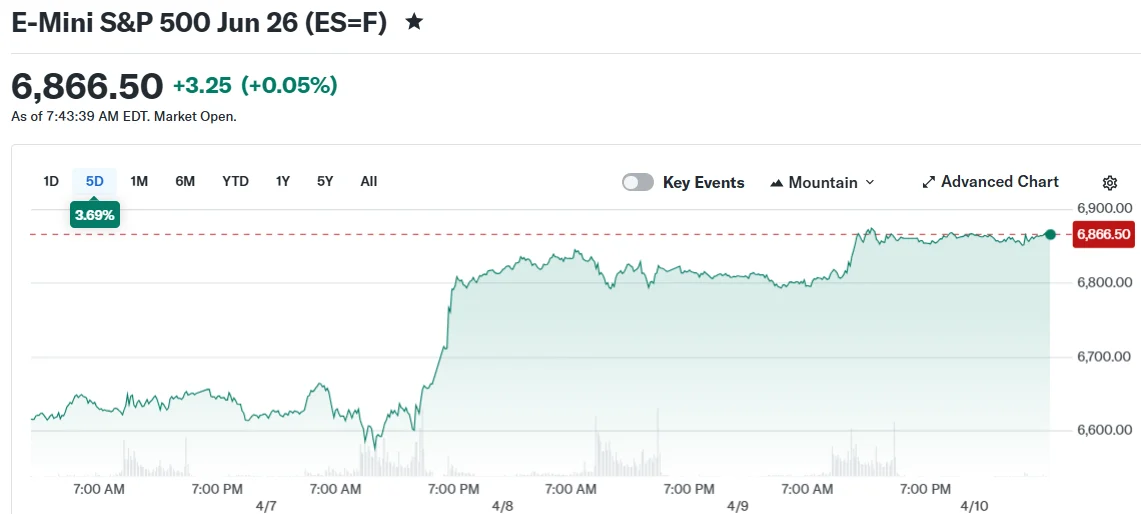
Thursday’s trading concluded with gains across all three primary benchmarks, notably pushing the Dow into positive territory for the year 2026.
Market attention centers on the forthcoming consumer price index for March, representing the initial inflation assessment covering the timeframe following the outbreak of the Iran conflict. Wall Street economists project the headline figure will register a monthly gain of 0.9%, with annual comparisons showing a 3.3% elevation.
Deutsche Bank’s macro strategist Henry Allen emphasized the significance of this release. “It’s the first to cover the period since the Iran war began,” he noted.
Middle East Conflict Clouds Market Outlook
Geopolitical uncertainty in the Middle East continues casting a shadow over investor confidence. While Israeli Prime Minister Benjamin Netanyahu has consented to commence discussions with Lebanon, Israel’s formal statement clarified: “There is no ceasefire in Lebanon.”
Tehran’s leadership criticized Israel for allegedly violating the current ceasefire arrangement and implemented restrictions on tanker passage through the Strait of Hormuz. President Donald Trump addressed the situation via Truth Social, characterizing Iran’s performance as “very poor” regarding maintaining oil transit through the strategic passage.
🚨BREAKING:
🇮🇷🇵🇰🇺🇸 Iran says its negotiating team has not arrived in Islamabad, and the talks are on hold.
Tehran's condition: the U.S. must hold Israel to the ceasefire in Lebanon before negotiations can begin.
TL;DR: Iran may not show up.
Source: Tasnim https://t.co/5FNP0milF7 pic.twitter.com/HMjCaTB5wN
— Mario Nawfal (@MarioNawfal) April 10, 2026
Top-ranking White House representatives contacted Netanyahu mid-week, urging Israeli forces to reduce military operations in Lebanon. Diplomatic discussions are set to commence over the weekend.
Oil prices strengthened amid the geopolitical turbulence. Brent crude contracts gained 2% reaching $97.81 per barrel. West Texas Intermediate contracts increased 1.9% to $99.75 per barrel. Additionally, Saudi Arabia issued warnings that recent Iranian military actions have diminished its petroleum production capabilities.
Precious Metals, Fixed Income, and Currency Markets
Gold contracts declined 0.9% to $4,777 per ounce Friday morning, although the precious metal maintains positive momentum for the week.
The US dollar index strengthened 0.1% versus major global currencies. Treasury yields on the 10-year benchmark climbed 2 basis points to reach 4.30%.
Goldman Sachs analysts indicated that potential supply restoration from the Persian Gulf region would require multiple weeks before becoming reality.
The March inflation data represents Wall Street’s initial comprehensive assessment of how the petroleum price surge has impacted consumer costs following the commencement of hostilities involving Iran.
