

Key Highlights
- Q1 2026 sales reached €4.07 billion with 5.6% organic growth, falling short of the 7.1% analyst consensus.
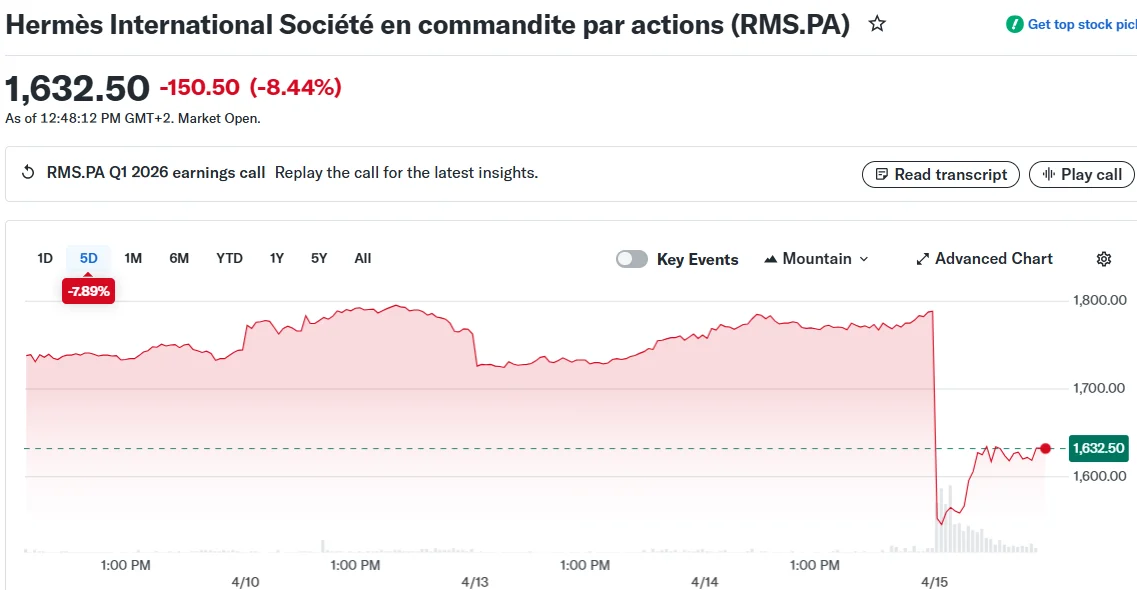
- Shares plunged over 13% during Paris trading, erasing approximately $20 billion in market capitalization.
- Geopolitical tensions in the Middle East subtracted roughly 150 basis points from growth, with regional revenues declining 13.4% annually.
- Asia-Pacific excluding Japan registered merely 2.2% growth, a dramatic deceleration from Q4 2025’s 8% expansion, sparking China demand worries.
- The Americas region emerged as a bright spot with 17.2% growth, significantly surpassing projections.
Shares of the iconic French luxury brand experienced a sharp downturn Wednesday following a first-quarter earnings report that disappointed Wall Street expectations. Challenges stemming from Asian market softness and Middle Eastern instability triggered a 13%-plus decline in Paris — representing one of the company’s steepest single-session losses in recent memory.
Hermès shares fell as much as 14% after Q1 sales rose 5.6% at constant currency, missing the 7.44% estimate, with the company pointing to weaker spending tied to the Middle East conflict and softer tourism in France. pic.twitter.com/t15KW4RTwZ
— Wall St Engine (@wallstengine) April 15, 2026
The luxury powerhouse recorded quarterly sales of €4.07 billion for the January-through-March period, representing a 5.6% organic expansion. While positive on the surface, this figure fell considerably short of the 7.1% growth rate Wall Street had anticipated. The performance also represents a notable deceleration from the robust 9.8% expansion achieved during Q4 2025.
When measured at actual exchange rates, the results appeared even more challenging. Foreign exchange headwinds totaling €290 million pushed the reported figures into negative year-over-year territory. Market expectations had called for approximately €4.16 billion in total revenue.
The ongoing Iran conflict created tangible business impacts. According to Jefferies research team estimates, Middle Eastern hostilities shaved roughly 150 basis points from quarterly revenue expansion. Wholesale distribution through regional concession partners and airport retail locations bore the brunt of disruption. Across the entire Middle Eastern market, revenues contracted 13.4% compared to the prior-year period.
Chinese Market Deceleration Sparks Investor Alarm
While Middle Eastern challenges grabbed headlines, investor attention quickly shifted to an even more troubling trend emerging from Asia-Pacific markets.
The Asia-Pacific segment excluding Japan managed only 2.2% quarterly growth — substantially below the 5.7% analyst consensus and representing a dramatic slowdown from the previous quarter’s 8% pace. Given Hermès’ significant exposure to affluent Chinese consumers, this kind of momentum loss immediately raises red flags.
Jefferies research analysts didn’t mince words: the Asia-Pacific ex-Japan performance “will be a major point of debate” and represents a “clear source of concern for fundamental investors.” The critical question facing investors is whether this represents a temporary pause or signals more enduring weakness in Chinese luxury consumption.
The stock’s pre-announcement weakness had already incorporated two primary risk factors, Jefferies noted — Middle Eastern exposure and decelerating Chinese demand. Wednesday’s financial disclosure validated both concerns.
Strong American Performance Provides Silver Lining
Amid the predominantly negative headlines, one geographic segment delivered impressive results. The Americas market posted 17.2% expansion, substantially exceeding analyst forecasts. This robust showing underscores the growing significance of North American luxury consumption.
Despite the quarterly disappointment, Hermès reaffirmed its medium-term financial outlook. Management stated the company has “moved into 2026 with confidence” despite navigating uncertain economic conditions and geopolitical volatility.
The shares declined as steeply as 13.6% during morning Paris trading before stabilizing around a 12.93% loss, closing at €1,551.50. The single-session wipeout eliminated more than $20 billion in shareholder value.
Hermès currently trades at a price-to-earnings multiple of 41.69x, consistent with its premium market positioning within the luxury goods industry. The company maintains a GF Score of 96/100, while its financial strength commands a 9/10 rating.
Management noted that Middle Eastern business trends have demonstrated sequential improvement during the opening weeks of the second quarter.
