


Key Takeaways
- Brent crude surged to $119 per barrel following Israeli military strikes on Iran’s South Pars gas facility before retreating to approximately $108.
- Qatar reports a 17% reduction in natural gas export capacity with potential repair timelines extending to five years following Iranian counterattacks.
- Saudi officials project oil prices could surge to $180 per barrel if Middle East supply disruptions persist through late April.
- Treasury Secretary Bessent proposed releasing approximately 140 million barrels of currently sanctioned Iranian crude to stabilize markets.
- Israeli Prime Minister Netanyahu indicated the conflict may conclude sooner than anticipated, contributing to modest Friday price declines.
Global energy markets experienced dramatic volatility this week as military confrontations between Israel and Iran intensified, damaging critical infrastructure throughout the Middle East and triggering widespread market uncertainty.
Brent crude futures climbed to $119 per barrel mid-week following Israeli military operations targeting Iran’s South Pars gas facility, recognized as one of the planet’s most significant natural gas reserves. By Friday morning, prices had moderated to approximately $107.87, while West Texas Intermediate declined to $94.46 per barrel, representing a 1.2% decrease.
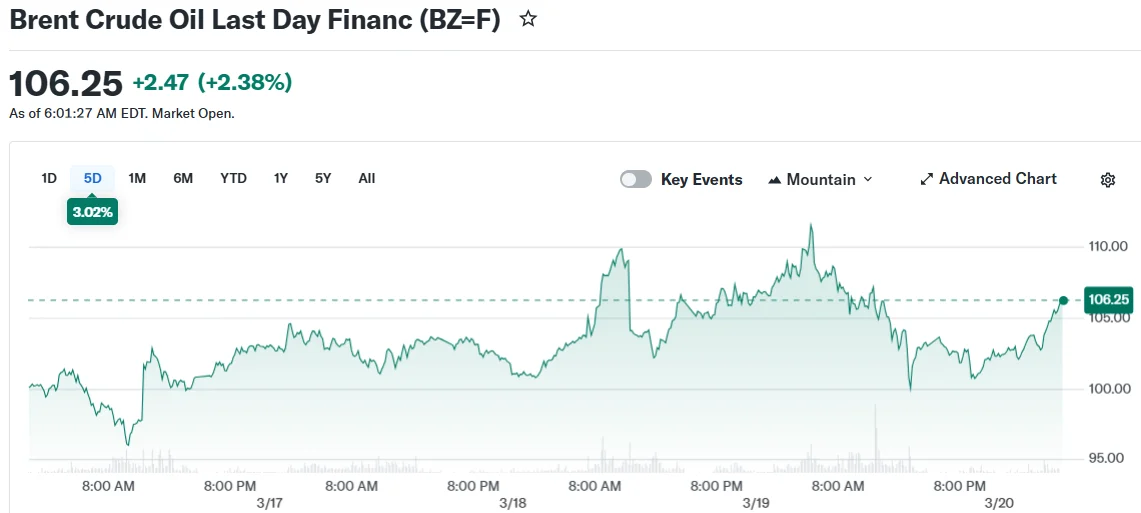
The price differential between Brent and WTI crude highlights the contrasting circumstances affecting international versus domestic oil markets. United States energy infrastructure remains undamaged, and speculation continues regarding potential Trump administration restrictions on U.S. crude exports designed to maintain lower domestic energy costs.
Following the Israeli operations, Iran executed retaliatory strikes throughout the region. U.S.-aligned nations detected incoming unmanned aerial vehicles and ballistic missiles. Israel subsequently launched operations targeting Tehran after missile warning systems activated in Jerusalem and northern territories.
Saudi Arabia is ramping up oil exports amid the Strait of Hormuz closure:
Crude oil shipments from Yanbu, a port on Saudi Arabia's Red Sea coast, are up to 4.19 million barrels per day.
This marks a +185% increase from the ~1.47 million barrels per day that moved through the… pic.twitter.com/E4YvfHHtgW
— The Kobeissi Letter (@KobeissiLetter) March 19, 2026
Qatar, ranking among the world’s leading liquefied natural gas exporters, verified that strikes damaged its Ras Laffan infrastructure. Officials announced a 17% reduction in export capabilities and estimated reconstruction could require up to five years. European markets, heavily reliant on Qatari natural gas imports, have witnessed regional benchmark prices spike substantially.
Measures to Stabilize Energy Markets
The Biden administration is actively pursuing strategies to stabilize energy markets. Treasury Secretary Scott Bessent indicated the United States could lift sanctions on Iranian crude currently in transit, potentially introducing roughly 140 million barrels into global markets. He additionally suggested deploying additional emergency petroleum reserves.
U.S. and coalition forces are intensifying operations to ensure safe passage through the Strait of Hormuz, the critical maritime chokepoint through which substantial global oil volumes transit. American naval vessels may provide escort services for commercial shipping if Iranian attack threats diminish. However, Vital Knowledge analysts emphasize that completely reopening the waterway necessitates either significant military intervention or successful diplomatic negotiations.
Israeli Prime Minister Benjamin Netanyahu revealed Thursday that President Donald Trump requested Israel cease operations targeting Iranian energy infrastructure. Netanyahu further stated the conflict would conclude “a lot faster than people think,” contributing to modest oil price declines.
Trump informed journalists he would take necessary actions to resolve the crisis but confirmed no plans exist to deploy ground forces. He mentioned the Pentagon submitted a $200 billion war funding request to the White House.
Potential Price Trajectory for Crude Oil
Saudi Arabian energy officials informed the Wall Street Journal that crude prices could exceed $180 per barrel should the conflict and associated supply interruptions extend into late April. Financial markets are currently attempting to factor in this worst-case scenario.
WTI futures have declined nearly 5% across the previous five trading sessions, suggesting some market optimism regarding possible conflict resolution. Nevertheless, energy analysts caution that even with Strait of Hormuz reopening, physical damage to production infrastructure could constrain global supply for extended periods.
Iran’s Supreme Leader Mojtaba Khamenei declared that “safety must be taken away from our domestic and foreign enemies.” His predecessor, Ali Khamenei, was killed previously in the conflict as Israeli forces worked to dismantle Iran’s governing structure.
