


TLDR
- Major U.S. indexes are heading toward their fourth consecutive week of declines
- The Dow faces its longest losing stretch since early 2023
- Brent crude oil continues trading near $108 per barrel amid geopolitical tensions
- Market volatility intensified following reports of potential U.S. blockade plans for Iran’s key oil terminal
- Cryptocurrency markets experienced simultaneous declines, with Bitcoin and XRP posting weekly losses
Friday, March 20, brought another session of losses for U.S. equity markets, extending what has become a persistent downturn across all major benchmarks. The sustained decline stems primarily from escalating oil costs and continued volatility surrounding the Iran military situation.
The Dow Jones Industrial Average shed approximately 300 points during Friday’s session, representing a decline of roughly 0.7%. Meanwhile, the S&P 500 retreated about 1%, while the tech-heavy Nasdaq Composite experienced the steepest drop at approximately 1.3%.
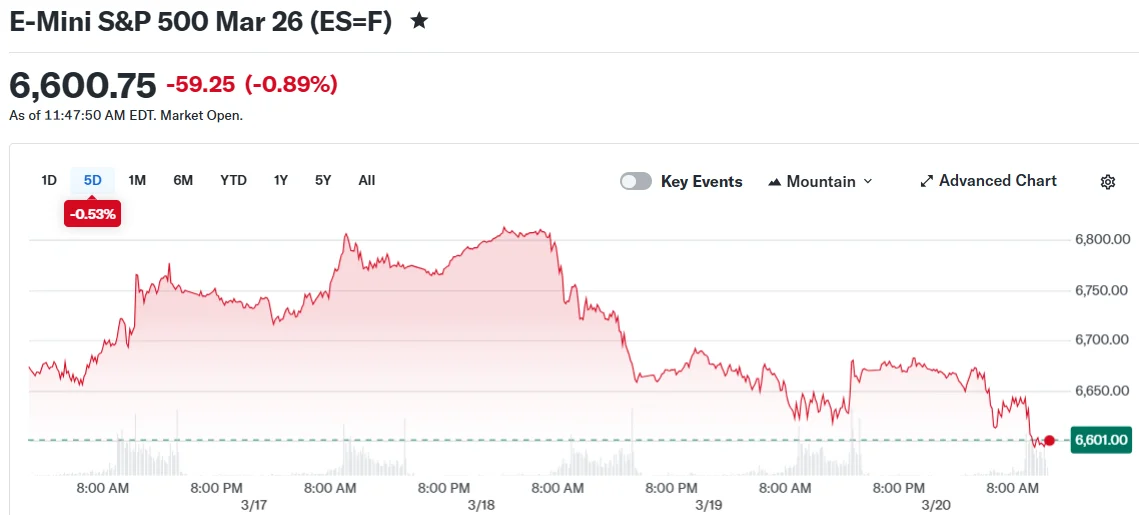
Should the Dow complete this fourth consecutive week in negative territory, it would represent the index’s most extended period of decline since late February 2023. The S&P 500’s last four-week losing period occurred in March 2025.
The Nasdaq has already weathered a five-week downturn earlier this year and is once again flirting with correction levels, joining the Dow in precarious technical territory.
Market sentiment has remained fragile ever since combined U.S.-Israeli military operations against Iran commenced on February 28. Elevated crude prices throughout this period have consistently dampened investor confidence.
Brent crude contracts traded around $108 per barrel Friday, while West Texas Intermediate futures hovered near $96. Both oil benchmarks experienced choppy trading patterns with alternating gains and losses throughout the day.
Friday’s market anxiety intensified following an Axios report suggesting the Trump administration may be evaluating plans to either occupy or establish a blockade around Kharg Island—Iran’s critical oil export facility—as leverage to force Iran to reopen the Strait of Hormuz for commercial tanker passage.
Iran continued its offensive operations against neighboring Persian Gulf states on Friday. Market analysts have cautioned that existing infrastructure damage will likely sustain elevated oil prices for an extended period.
Why Oil Prices Are Driving Markets
Paul Hickey, co-founder of Bespoke Investment Group, noted that Friday’s trading direction would “depend almost entirely on the price of oil.” Without significant economic releases or corporate earnings on the calendar, Middle East developments remained the primary market catalyst.
Friday’s session coincided with triple witching—a quarterly occurrence when three types of derivatives contracts (stock options, stock index futures, and stock index options) expire simultaneously. These sessions typically feature heightened volatility and trading volumes.
David Laut, chief investment officer at Kerux Financial, suggested that triple witching dynamics could amplify market movements given the already fragile sentiment prevailing before the opening bell.
Thursday’s session saw the S&P 500 slip beneath its 200-day moving average, a technical threshold that many chart analysts monitor closely. Frank Cappelleri of CappThesis noted that while a single breach of this level doesn’t necessarily signal additional downside, it represents a critical juncture where investors reassess their positions and consider potential buying opportunities.
Crypto Also Takes a Hit
Equity markets weren’t alone in their struggles this week. Bitcoin and XRP both recorded losses, contributing to broader weakness across digital asset markets. Meanwhile, the SEC’s endorsement of a Nasdaq initiative to tokenize securities generated discussion within the cryptocurrency community, though it failed to provide meaningful price support during Friday’s session.
Both the Dow and Nasdaq concluded the week approaching correction thresholds, with market participants closely monitoring every development emerging from the Middle East for directional cues.
