


Key Takeaways
- Ethereum declined from $2,220 to reach a bottom at $2,025, currently consolidating between $2,020 and $2,100
- Dual bearish trendlines have emerged, establishing resistance zones at $2,120 and $2,165
- Breaking above $2,165 could trigger a rally toward $2,200–$2,300; falling beneath $2,025 may lead to a decline toward $2,000 or below
- Weekly net outflows from Ethereum spot ETFs totaled $59.94 million, with BlackRock’s ETHA recording the largest exodus at $69.59 million
- Cumulative net assets in Ethereum spot ETFs now total $12.33 billion, representing a 4.79% ratio to total market capitalization
Ethereum experienced a significant pullback during the most recent trading session, sliding from approximately $2,385 down to a session low of $2,025. Currently, the cryptocurrency is changing hands beneath the $2,100 threshold and trading below its 100-hourly Simple Moving Average.
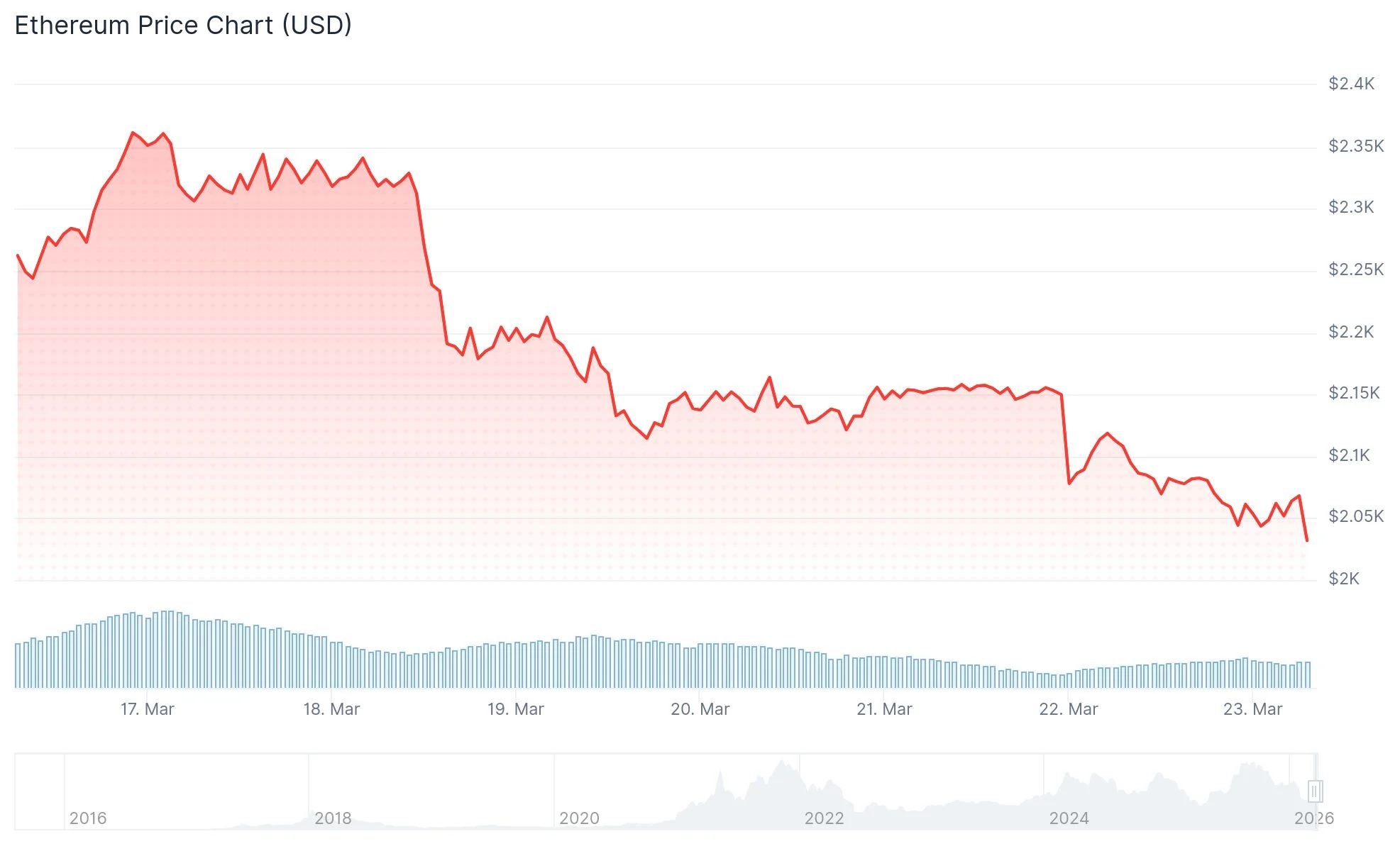
The downward movement initiated after ETH couldn’t maintain support above the $2,220 mark. Price action subsequently breached the $2,150 and $2,120 levels before momentarily dropping under $2,050.
Presently, ETH is consolidating its recent losses beneath the 23.6% Fibonacci retracement measurement of the downward swing from $2,385 down to $2,025. Analysis of the hourly chart reveals two descending trendlines, establishing resistance barriers at $2,120 and $2,165.
The initial critical resistance threshold appears at $2,120, which coincides with the 100-hourly Simple Moving Average. Successfully breaching this level would bring $2,165 into focus as the subsequent obstacle.
Should ETH overcome $2,165 resistance, the 50% Fibonacci retracement target sits around $2,200. Clearing this zone could pave the way for advancement toward $2,250 or potentially $2,300.
Critical Support Zones Under Scrutiny
On the support side, the immediate cushion appears near $2,040. Beneath this threshold, the $2,025 area represents the primary foundational level.
A decisive breach below $2,025 would shift attention toward the psychological $2,000 mark. Additional downside pressure could bring $1,965 into consideration, with $1,880 serving as a more substantial support base.
$ETH seems to be forming head and shoulder pattern.
If Ethereum loses the $2,040 level, expect a massive dump. pic.twitter.com/EZGbDEYvq2
— Ted (@TedPillows) March 22, 2026
Market analyst Ted Pillows shared his technical assessment on X, suggesting that ETH may be developing a head and shoulders configuration. His analysis stated: “$ETH seems to be forming head and shoulder pattern. If Ethereum loses the $2,040 level, expect a massive dump.”
ETF Capital Outflows Create Additional Headwinds
Ethereum spot exchange-traded funds registered cumulative net outflows totaling $59.94 million during the trading week spanning March 16 through March 20, based on SoSoValue analytics cited by PANews on March 23.
From March 16 to March 20 (ET), Bitcoin spot ETFs recorded net inflows of $95.18 million, marking four consecutive weeks of net inflows. Ethereum spot ETFs saw net outflows of $59.94 million. SOL spot ETFs recorded net inflows of $21.10 million, while XRP spot ETFs saw net… pic.twitter.com/oI6NJjhwZl
— Wu Blockchain (@WuBlockchain) March 23, 2026
BlackRock’s ETHA product experienced the most substantial withdrawals, with $69.59 million exiting the fund throughout the week. Despite this recent outflow, ETHA’s cumulative historical net inflow remains at $11.91 billion.
Fidelity’s FETH product recorded $61.62 million in net withdrawals during the identical timeframe. The fund’s aggregate historical net inflow stands at $2.32 billion.
The sole ETF product registering positive net inflows last week was the Grayscale Ethereum Mini Trust (ETH), which attracted $6.87 million in new capital. This product’s total historical net inflow has accumulated to $1.85 billion.
As of March 23, aggregate net assets held across all Ethereum spot ETF products total $12.33 billion, accounting for 4.79% of Ethereum’s complete market capitalization. The cumulative historical net inflow across the entire Ethereum ETF ecosystem has reached $11.73 billion.
