

Key Takeaways
- Citi maintains its 7,700 year-end forecast for the S&P 500 amid mounting challenges
- Projected index earnings of $320 for 2026, initially seen as aggressive, now appear cautious
- Iranian conflict represents the nearest-term danger to market stability
- Additional concerns include artificial intelligence disruption, private credit vulnerabilities, and trade policy uncertainty
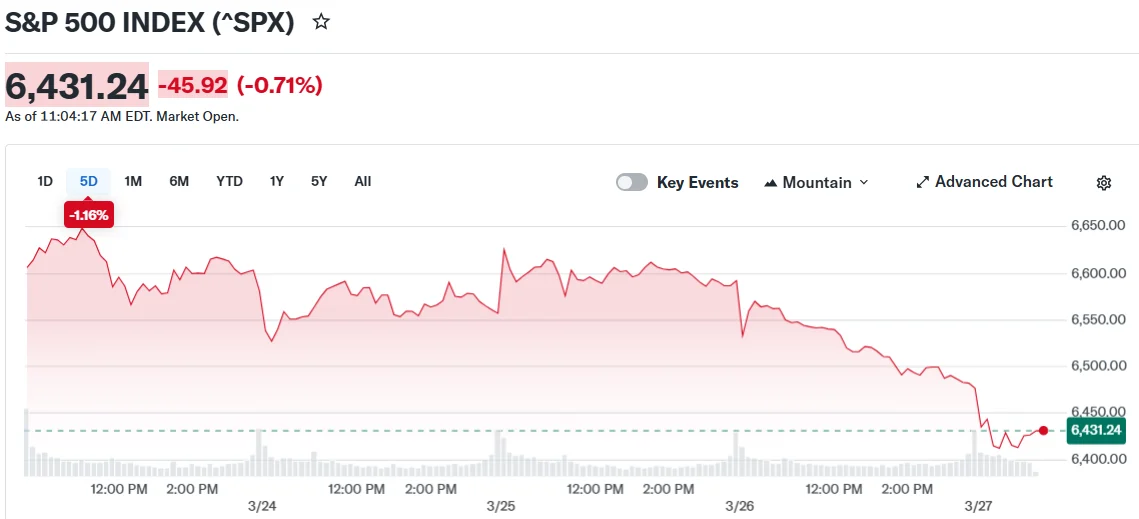
- The S&P 500 has declined roughly 6.7% since January, trading around 6,417
Citi continues to stand behind its 7,700 year-end projection for the S&P 500, maintaining its stance despite an expanding array of challenges that could undermine what the financial institution describes as an ideal economic environment.
The bank’s outlook is anchored by anticipated earnings of $320 per share for the 2026 calendar year. This figure initially appeared ambitious when announced earlier this year. However, Citi now characterizes it as understated following a robust fourth-quarter earnings season that pushed 2025 full-year earnings to approximately $276.
Current bottom-up consensus estimates have climbed to $321.3, edging past Citi’s internal projection.
The institution has also outlined two contrasting scenarios. An optimistic outlook points to 8,300, reflecting accelerated profit expansion and elevated valuations. A pessimistic scenario envisions 5,700, driven by deteriorating fundamentals and compressed multiples.
With the S&P 500 hovering around 6,417, reaching the baseline 7,700 target would necessitate approximately 20% appreciation from present levels.
The benchmark index has shed about 6.7% since the beginning of the year, as mega-capitalization technology stocks surrendered substantial gains accumulated in 2025.
International Tensions and Economic Concerns
Citi’s research team, headed by Scott Chronert, identified escalating tensions with Iran as the most pressing near-term threat. Extended hostilities could drive energy prices higher, squeezing consumer budgets and negating potential fiscal policy advantages.
The strategists also highlighted risks stemming from artificial intelligence transformation, vulnerabilities within private credit sectors, and persistent ambiguity surrounding international trade agreements and tariff implementations.
Even with these headwinds, Citi has decided against adjusting its projections. “We maintain our full year targets for now,” the institution confirmed.
From a macroeconomic perspective, Citi’s economics division anticipates the Federal Reserve will implement three quarter-point rate reductions between June and September, lowering the target range to 2.75–3.0% by December.
Economic expansion is projected to gain momentum on a year-over-year basis before decelerating during the latter months of 2026.
Corporate Profits and Sector Performance
The Information Technology sector has experienced the most significant upward adjustments to earnings forecasts, with 2026 projections rising more than 11% since the start of the year.
The group of eight mega-capitalization technology companies continues to dominate earnings revision momentum across the S&P 500. However, Citi observes that the remaining constituents are beginning to shoulder more of the growth burden.
The “other 492” corporations within the index are projected to deliver low-double-digit earnings expansion in 2026, emerging from a profit contraction that characterized 2024.
Year-to-date performance shows the Elite 8 mega-caps declining approximately 10%, while the broader market has registered modest gains. This represents an inversion of 2025 dynamics, when mega-capitalization stocks delivered roughly 25% returns compared to 14% for the remaining market participants.
Smaller-capitalization equity benchmarks have demonstrated greater resilience, advancing more than 3% and 4% for small-cap and mid-cap indices respectively in 2026.
Citi’s proprietary Levkovich sentiment indicator has climbed into the upper range of neutral territory.
The S&P 500 currently trades near 6,417, representing a decline of approximately 6.7% year-to-date.
