

Key Highlights
- Gold futures declined 0.4% to $4,666.70 per troy ounce amid geopolitical uncertainty
- President Trump issued an ultimatum to Iran: reopen the Strait of Hormuz by 8 p.m. ET Tuesday or face military action
- Approximately 20% of the world’s oil supply transits through the strategic waterway
- People’s Bank of China extended its gold purchasing streak to 17 consecutive months, now holding 74.38 million troy ounces
- Dollar index trades at 100.03, gaining approximately 0.8% over the past month and weighing on precious metals
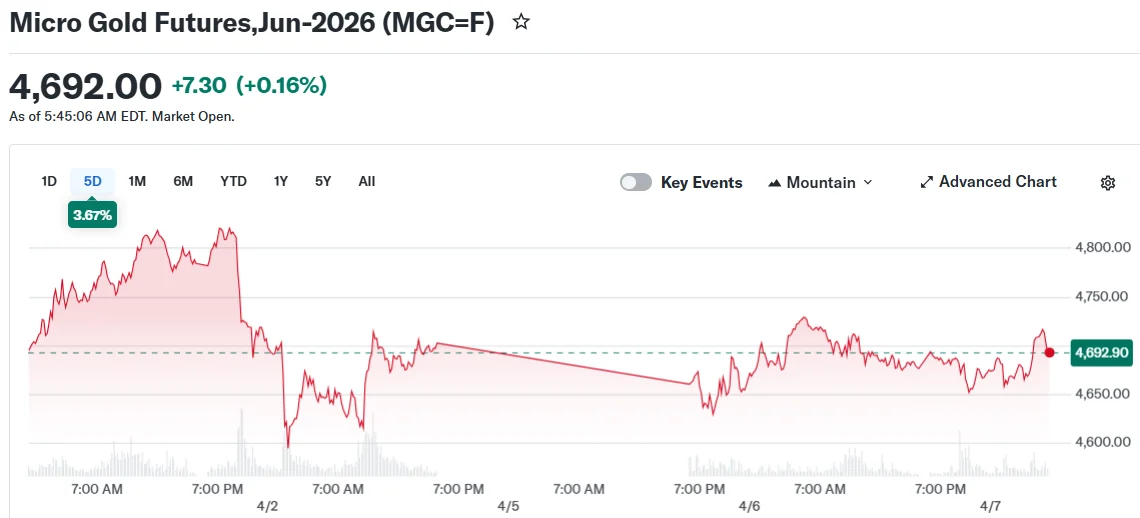
Precious metal markets displayed divergent behavior on Tuesday as geopolitical tensions escalated. New York gold futures declined 0.4% to settle at $4,666.70 per troy ounce, while spot prices climbed 0.8% to reach $4,685.54 per ounce during early trading hours. Meanwhile, June delivery gold futures advanced 0.6% to $4,710.84 per ounce.
The fragmented price action reflects market uncertainty as investors monitor President Donald Trump’s ultimatum to Tehran regarding the Strait of Hormuz. The president has demanded Iran agree to reopen the critical shipping lane by 8 p.m. Eastern Time on Tuesday, threatening strikes against Iranian energy facilities if compliance is not forthcoming.
In characteristically forceful language, Trump pledged to obliterate “every bridge” and “power plant” across Iran should the deadline expire without agreement. He further cautioned that rebuilding efforts would require “100 years” following potential U.S. military operations.
BREAKING: President Trump says he will strike "every power plant and every bridge" in Iran if they do not make a deal by "Tuesday evening," per WSJ.
— The Kobeissi Letter (@KobeissiLetter) April 5, 2026
The Strait of Hormuz represents a critical chokepoint in global energy markets. This narrow waterway along Iran’s southern coastline facilitates the passage of roughly one-fifth of the planet’s oil supply.
Tehran has responded by requesting a comprehensive settlement encompassing sanctions removal, security assurances, and financial compensation for sustained damages. Intelligence from Washington suggests the administration views these conditions as unacceptable.
Despite the aggressive rhetoric, Trump maintained that diplomatic resolution remains achievable. The current confrontation originated from coordinated U.S.-Israeli military operations targeting Iran in late February.
Crude Markets and Currency Movements Create Headwinds
Brent crude prices maintained positions above $110 per barrel as the deadline approached. Elevated oil prices intensify inflationary pressures, potentially compelling central banks to sustain restrictive monetary policies for extended periods.
This dynamic carries significant implications for gold valuations. As a non-yielding asset, precious metals become less attractive when elevated interest rates boost returns on competing investments. Research analysts at ANZ noted that Trump’s aggressive posturing “impacted risk appetite” while simultaneously strengthening the U.S. dollar and lifting Treasury yields.
The U.S. dollar index registered 100.03, despite experiencing a modest 0.2% decline on Tuesday. Over the trailing 30-day period, the greenback has appreciated roughly 0.8%. During this identical timeframe, spot gold prices have retreated more than 8%.
Dollar appreciation increases gold’s cost for international buyers utilizing alternative currencies, consequently dampening global demand.
Chinese Central Bank Maintains Accumulation Strategy
A supportive element for gold markets emerged from China’s ongoing reserve diversification. The People’s Bank of China expanded its gold holdings for an unprecedented 17th consecutive month. Official reserves climbed to 74.38 million fine troy ounces by March’s conclusion, up from 74.22 million ounces recorded in February.
Persistent central bank accumulation provides fundamental demand support for precious metals markets.
As Tuesday morning progressed, financial markets remained in a state of heightened alertness, awaiting the 8 p.m. ET deadline and Tehran’s potential response.
