


Key Takeaways
- Aster derivatives exchange has eliminated its fixed monthly token distribution in favor of a staking-exclusive emission framework
- New token releases plummet from 78.4 million ASTER monthly to approximately 1.8–2.25 million — representing a 97% cut
- More than 80% of the platform’s 8 billion token allocation was designated for community distribution
- The tokenomics revision addresses user concerns regarding excessive dilution and complements the platform’s active token buyback initiative
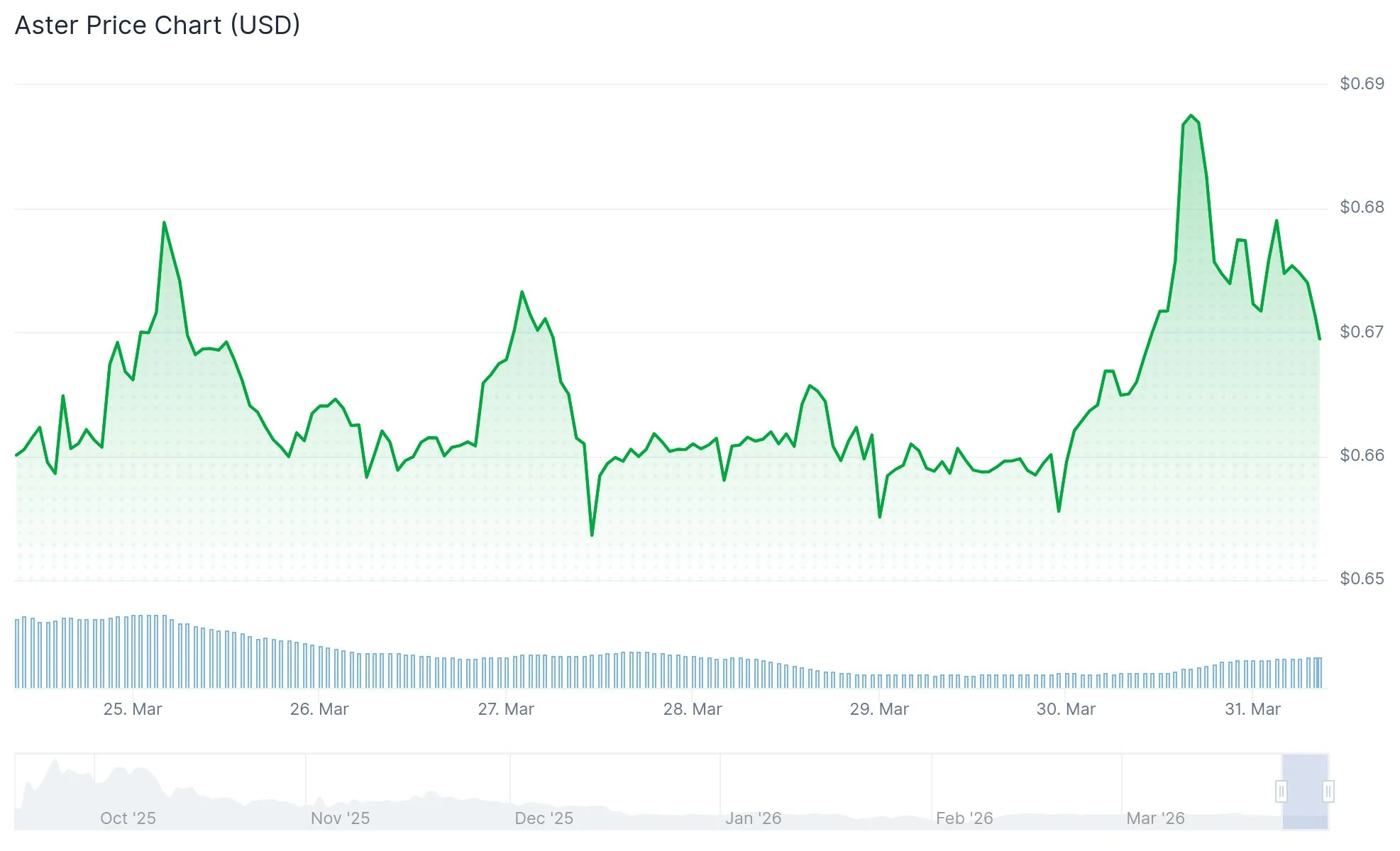
- ASTER has gained close to 3% over the last 24-hour trading period
Aster, the decentralized derivatives trading platform that counts Binance founder Changpeng Zhao among its backers, has executed a comprehensive restructuring of its token distribution mechanics. The exchange revealed it is abandoning its predetermined monthly release framework in favor of an emission system tied exclusively to staking participation.
Under the previous arrangement, Aster distributed 78.4 million ASTER tokens monthly — approximately 1% of its 8 billion total token supply — following a straightforward linear timetable. This figure will now contract to a range between 1.8 million and 2.25 million tokens each month.
[Important Notice] Tokenomics Update: Restructuring Ecosystem Emissions
We are replacing the monthly Ecosystem unlock with a staking-only emission model, significantly reducing the amount of $ASTER entering circulation each month.
Previously, 78.4M $ASTER (~1% of max supply)…
— Aster 🥷 (@Aster_DEX) March 30, 2026
This represents a monthly supply reduction exceeding 97% compared to the original emission schedule.
The protocol implemented this adjustment following direct input from its user base regarding excessive token dilution. According to Aster’s announcement, the primary objective centers on minimizing downward price pressure stemming from new ASTER entering the market.
Moving forward, ecosystem-designated tokens will be distributed exclusively through staking reward mechanisms. The platform has established 450,000 ASTER per weekly epoch as the current distribution rate.
Mechanics of the Revised Token Distribution Framework
The 30% supply allocation classified under Ecosystem & Community holdings — initially scheduled for linear distribution across 20 months — now serves as the exclusive reservoir for staking incentives. This allocation additionally funds the APX-to-ASTER token migration process, development grants, promotional activities, and liquidity provisioning initiatives.
Aster operates a two-tier staking compensation structure. This encompasses a 150,000 ASTER Base APY component alongside a 300,000 ASTER Loyalty Rewards mechanism that increases payouts based on token lock duration and platform engagement levels.
The Aster Foundation maintains a 7% treasury reserve that remains completely locked until community governance procedures authorize its release. Team-allocated tokens, comprising 5% of total supply, are subject to a 12-month cliff period followed by linear vesting across an additional 40 months.
Airdrop allocations represent more than 53% of the complete token supply. During the token generation event on September 17, 2025, 8.8% became immediately accessible to recipients. The remaining airdrop tokens unlock gradually over an 80-month timeline.
Token Buyback Initiative Creates Deflationary Dynamics
Aster maintains an ongoing buyback mechanism that debuted in December of last year. The program allocates up to 80% of daily trading fees toward open market purchases of ASTER tokens.
When paired with the substantially reduced emission framework, Aster indicates the token economics could potentially shift to net deflationary territory as buybacks exceed new issuance.
Aster unveiled its proprietary Layer-1 blockchain infrastructure earlier this month, designated as Aster Chain. The network emphasizes privacy preservation and high-throughput capabilities specifically engineered for derivatives market operations.
The platform operates in a competitive landscape alongside Hyperliquid and Lighter, both of which similarly deploy purpose-built blockchain architectures.
ASTER has appreciated nearly 3% during the past 24-hour window at the time of publication.
