


Key Takeaways
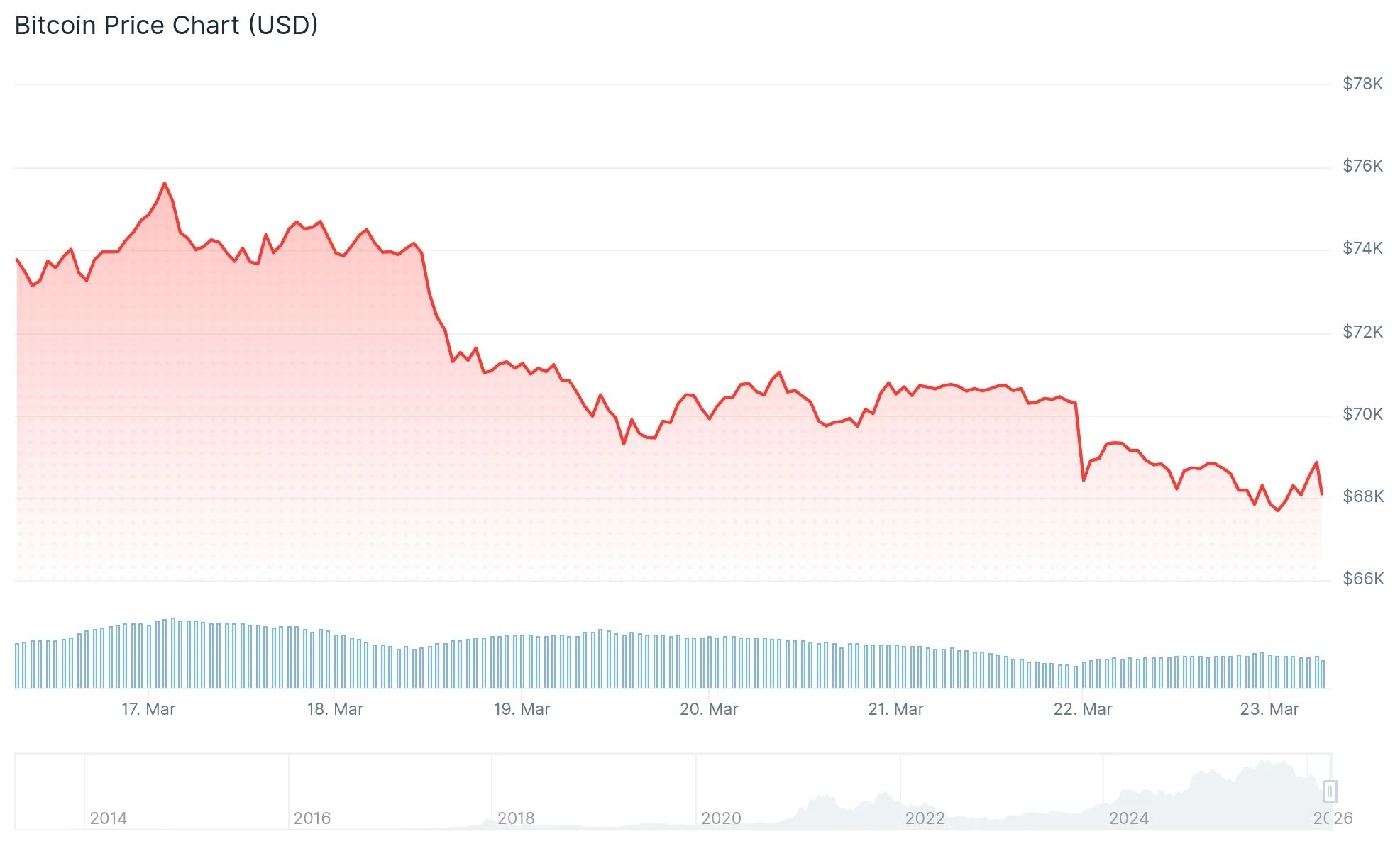
- Bitcoin declined to approximately $68,652, shedding 0.7% during Monday’s session as escalating Iran tensions drove capital away from risky assets.
- President Trump issued a 48-hour ultimatum to Iran demanding the Strait of Hormuz be reopened or face targeted military action.
- BTC has declined more than 20% since the start of the year, though it has gained roughly 6% over the last 30 days.
- Critical support level is positioned at $67,250, with potential downside targets extending to $65,000 or $63,500 if breached.
- Bitcoin spot exchange-traded funds attracted $95.18 million in net inflows during the week of March 16-20, continuing a four-week positive streak.
Bitcoin retreated to $68,652 during Monday’s trading session, declining 0.7% as heightened concerns surrounding the U.S.-Israel standoff with Iran prompted investors to exit risk-on positions. This downward movement continued the weekend’s bearish momentum and pushed BTC further below its monthly peak above $72,000.
The market-wide decline was comprehensive. Equities, precious metals, and foreign exchange markets all experienced losses in tandem with digital assets as traders responded to escalating Middle Eastern geopolitical concerns.
President Donald Trump delivered a 48-hour warning to Iran over the weekend, insisting the nation must reopen the Strait of Hormuz or face American military action targeting vital energy facilities. Tehran countered by warning it would completely seal the strategic waterway and strike essential energy and water systems throughout the Gulf region.
[[EMBED_0]]
The confrontation has now persisted for four straight weeks with no indication of de-escalation.
Technical Analysis for Bitcoin
Bitcoin pierced through the $71,200 and $70,000 levels earlier in the session, reaching a low of $67,343 before staging a modest bounce. The cryptocurrency is currently positioned beneath the 100-hour simple moving average, with a descending trendline establishing resistance near $69,200.
[[EMBED_1]]
For bulls to regain control, BTC must reclaim $69,200 and maintain ground above the $70,000 threshold to reverse the short-term bearish bias. Success would open doors to subsequent resistance zones at $71,650 and $72,800.
Should the weakness persist, traders are monitoring the initial support floor at $67,250. A breakdown beneath that level would bring $66,500 and subsequently $65,000 into focus. The $63,500 region represents a significant support zone.
Bitcoin Versus Gold Performance
Despite the recent pullback, Bitcoin has outperformed gold throughout the past 30 days. BTC has advanced approximately 6% during this timeframe, whereas gold has retreated about 18% from its late-January all-time high, pressured by substantial profit-taking activity.
Gold has also struggled to capture safe-haven buying during the Iran crisis, partially because market participants are concerned the conflict could fuel worldwide inflation and prompt higher borrowing costs.
On a year-to-date basis, however, Bitcoin remains down more than 20%, while gold trades approximately unchanged.
Alternative cryptocurrencies also posted losses on Monday. Ether decreased 2.2% to $2,061.77, XRP fell 1.9% to $1.3853, and Dogecoin declined 1.3%.
[[EMBED_2]]
Wu Blockchain disclosed that Bitcoin spot exchange-traded funds registered net inflows totaling $95.18 million during the period spanning March 16 through March 20, representing the fourth straight week of positive capital flows into BTC ETF vehicles.
