

Key Takeaways
- Brent crude surged past $106 per barrel on Thursday with approximately 4% gains, while WTI reached $93.66
- Critical shipping lane through the Strait of Hormuz continues blockade, disrupting roughly 20% of worldwide petroleum transport
- Tehran dismissed Washington’s diplomatic approaches as Iranian lawmakers prepare legislation to impose transit fees through the waterway
- BlackRock leadership cautioned that crude could reach $150 per barrel regardless of immediate ceasefire agreements
- American government officials are conducting internal assessments on economic impacts of $200 per barrel scenarios
Energy markets experienced significant volatility on Thursday as diplomatic tensions between Washington and Tehran escalated. Brent crude registered approximately 4% growth, reaching $106.34 per barrel, while West Texas Intermediate advanced 3.7% to settle at $93.66.
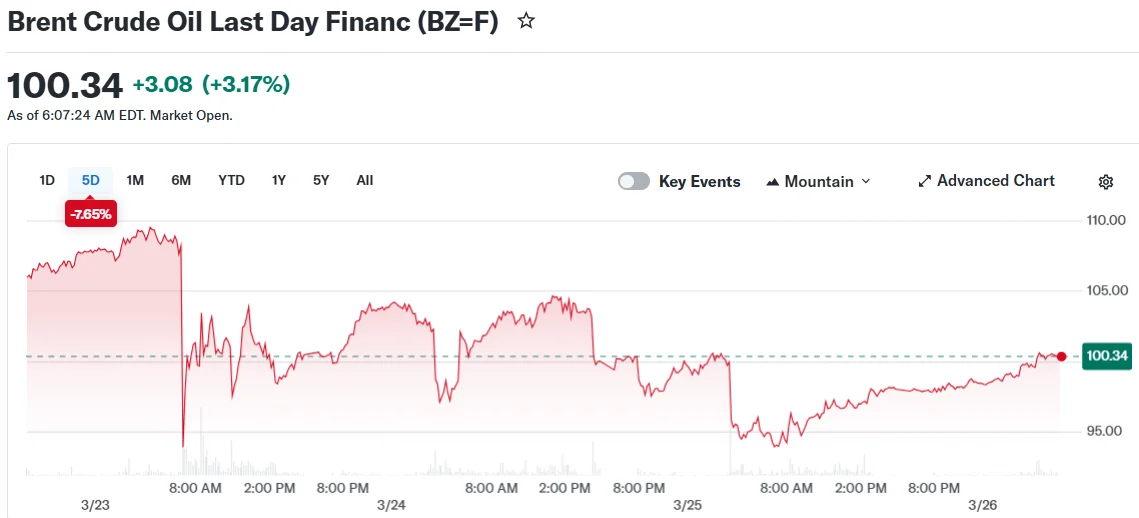
These increases reversed the previous session’s decline of over 2%, which had been fueled by temporary market optimism regarding potential diplomatic breakthroughs. However, that sentiment quickly evaporated.
Iranian leadership publicly refuted claims of direct diplomatic engagement with Washington. Tehran’s representatives emphasized substantial outstanding disagreements and presented their own stipulations, prominently featuring absolute sovereignty over the strategic Strait of Hormuz.
Washington responded by reaffirming that diplomatic channels remain active. During a Wednesday evening fundraiser, President Trump stated that Iran “desperately wants an agreement, but they’re reluctant to admit it publicly.”
Iranian legislators are currently drafting legislation that would impose fees on vessels transiting the strait under the pretext of security services. According to the semi-official Fars news agency, this proposal should reach completion within the coming week.
https://twitter.com/BSCNews/status/2037053183499924004?s=20
The Strait of Hormuz represents a critical chokepoint linking the Persian Gulf to international energy markets. Approximately 20% of global petroleum shipments transit this narrow passage. Since hostilities commenced in late February, commercial tanker movement has been severely restricted.
Vessels requesting Iranian escort services must submit comprehensive crew rosters, cargo manifests, and voyage particulars to the Islamic Revolutionary Guard Corps for authorization before proceeding.
Analysts Warn of Additional Price Escalation
BlackRock president Rob Kapito suggested market participants may be undervaluing ongoing risks. During Thursday remarks in Melbourne, Kapito projected that crude could still climb to $150 per barrel even with an immediate cessation of hostilities, citing the extended timeline required for supply network restoration.
Administration officials in Washington are also conducting confidential analyses examining scenarios involving $200 per barrel pricing, according to informed sources.
Brent crude is tracking toward its largest monthly percentage increase since 1990. Earlier this month, prices briefly approached $120 per barrel before retreating.
A drone attack targeted a Turkish vessel transporting Russian petroleum near Istanbul in the Black Sea on Wednesday, introducing additional uncertainty for traders monitoring multiple geopolitical flashpoints.
Worldwide Economic Strain Intensifies
Capital Economics analysts cautioned that an extended supply disruption could generate economic damage comparable to the aftermath of Russia’s 2022 Ukraine invasion, potentially prompting central banks to resume interest rate increases.
Asian nations are experiencing immediate consequences. Thailand implemented gasoline price increases reaching 22% on Thursday. The Philippines suspended its wholesale electricity spot market operations. Agricultural producers in India and China face escalating costs for chemical inputs.
Fuel prices at American service stations have climbed consistently since the conflict’s onset.
The White House confirmed on Thursday that a previously scheduled summit between President Trump and Chinese leader Xi Jinping has been moved to May 14–15 in Beijing
