

TLDR
- Brent crude temporarily slipped under the $100 threshold, declining more than 5% before regaining some losses
- Trump announced the US could withdraw from Iran in two to three weeks
- Crude prices remain approximately 40% elevated compared to pre-war levels from late February
- The Strait of Hormuz, through which roughly 20% of the world’s oil passes, continues to face severe disruptions
- American crude stockpiles increased by 10.26 million barrels in the previous week, significantly exceeding forecasts
Crude markets experienced dramatic volatility on Wednesday following President Donald Trump’s suggestion that the United States could conclude its involvement in the Iran conflict within a matter of weeks, driving Brent crude temporarily beneath the $100 per barrel threshold for the first time since hostilities commenced.
Brent crude experienced a decline exceeding 5% at its session low before mounting a partial recovery. The benchmark was most recently changing hands near $102.25 per barrel. Prior to the outbreak of conflict in late February, Brent was valued around $70 per barrel.
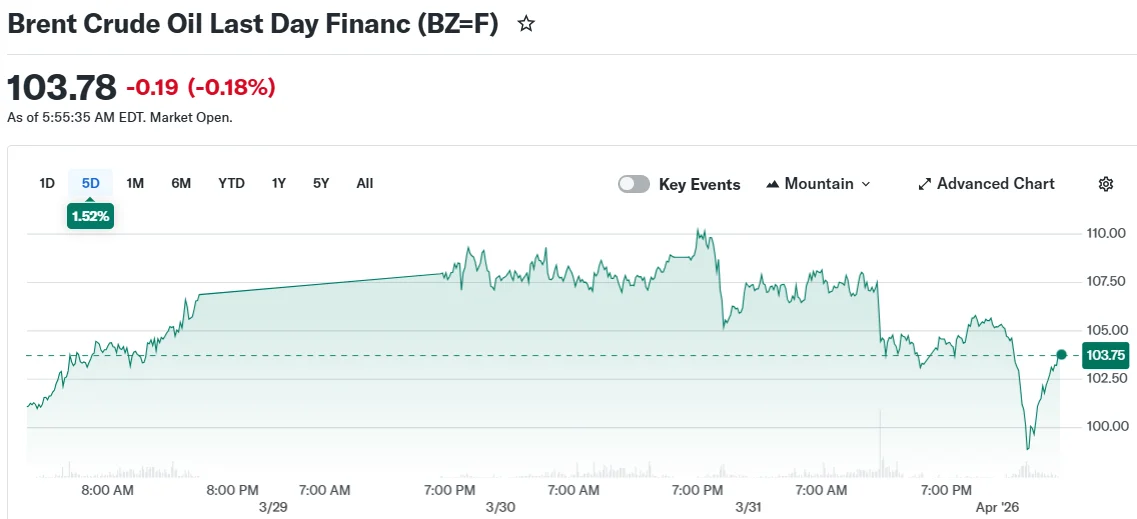
US West Texas Intermediate crude similarly retreated, falling 2.4% to reach $98.92 per barrel.
Speaking to journalists at the White House, Trump stated the US could depart Iran within “two to three weeks.” He added that Iran wouldn’t necessarily need to finalize a formal agreement for hostilities to cease.
NOW – Trump says the U.S. will leave the Iran War in 2 or 3 weeks. pic.twitter.com/p0j83neowV
— Disclose.tv (@disclosetv) March 31, 2026
Iran’s president suggested the nation possesses the “necessary will” to conclude the conflict provided it receives assurances against future attacks. Iranian Foreign Minister Abbas Araghchi acknowledged that communications were being exchanged with the US while clarifying that no official negotiations were underway.
Trump was set to deliver an address to the nation Wednesday evening at 9 p.m. Eastern time, described by the White House as an “important update on Iran.”
Despite diplomatic signals suggesting de-escalation, military actions persisted on Wednesday. An oil tanker sustained damage near Qatar, igniting a blaze that was subsequently extinguished. Authorities reported no environmental contamination.
Why Oil Prices Remain Elevated
Oil prices continue trading approximately 40% above their pre-March levels. The Strait of Hormuz, a critical maritime corridor handling roughly one-fifth of global petroleum shipments, has witnessed tanker traffic virtually grind to a halt due to Iranian attack threats.
The International Energy Agency characterized the disruption as the most significant supply shock in recorded history. Fuel costs in certain markets have surged past $200 per barrel. American gasoline prices exceeded $4 per gallon this week for the first time since August 2022.
Market analysts have cautioned that even a limited reopening of the strait could require considerable time. Trump has indicated that US allies would need to participate in securing the waterway. The Wall Street Journal reported that the United Arab Emirates has encouraged Western and Asian nations to establish a coalition to forcibly reopen the passage.
China and Pakistan released a joint statement Tuesday advocating for an immediate ceasefire and the restoration of safe maritime transit.
Supply Data Points to Weaker Demand
Recent figures from the American Petroleum Institute revealed US crude stockpiles expanded by 10.26 million barrels during the previous week. This substantially exceeded the anticipated drawdown of 1.3 million barrels.
API chief Mike Sommers emphasized that reopening the Strait of Hormuz represented “the critical piece” for stabilizing international markets, cautioning that prices would continue climbing without restored petroleum flows.
A third US aircraft carrier strike group is currently en route to the Middle East, maintaining the potential for additional escalation.
