

Key Takeaways
- Gold futures declined 0.2% to settle at $4,400.50 per ounce amid U.S. dollar strength on Tuesday’s trading session.
- The precious metal has plummeted approximately 21% from its late-January record high of $5,594.82, with spot prices falling 2%.
- Market sentiment shifted after reports emerged that Saudi Arabia authorized U.S. military access to King Fahd air base.
- Major financial institutions including Global X ETFs and Standard Chartered maintain optimistic forecasts, projecting $5,375–$6,000 by year’s conclusion.
- Yardeni Research’s Ed Yardeni continues to stand by his ambitious $10,000 per ounce projection for decade’s end.
The precious metal market has witnessed gold cross into bear territory, shedding more than one-fifth of its value since reaching peak levels in January. However, market experts argue this downturn represents a temporary setback rather than a fundamental shift.
Spot gold prices experienced a decline of up to 2% during Tuesday’s session before recovering slightly, settling at $4,335.97 per ounce. Futures contracts dropped approximately 2% to reach $4,317.80. The yellow metal has surrendered roughly 21% from its late-January zenith of $5,594.82.
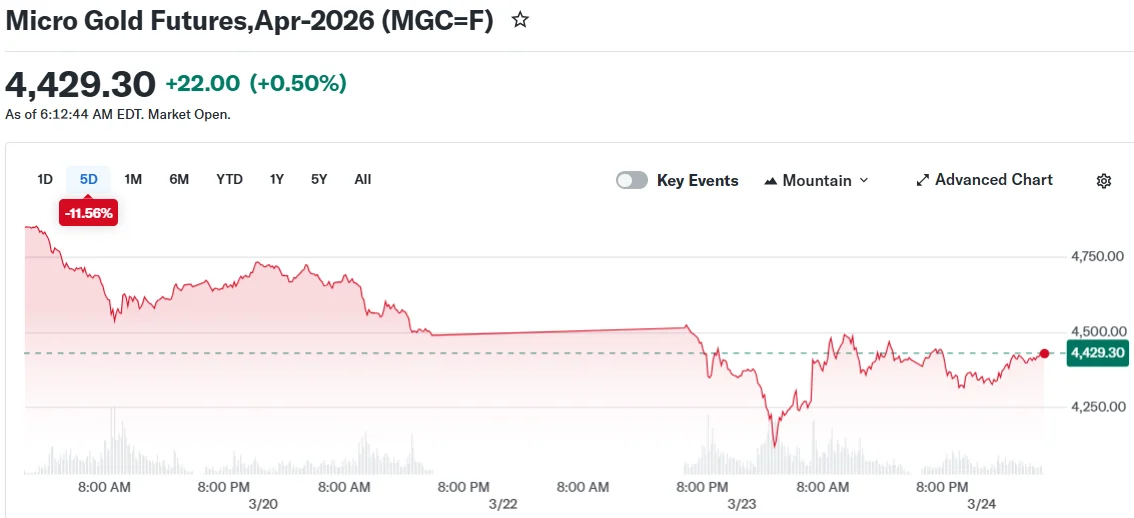
Continuous futures contracts for gold also experienced a modest 0.2% decline, reaching $4,400.50 per ounce. Meanwhile, the U.S. Dollar Index climbed 0.4%, exerting additional downward pressure on the commodity. Since gold trades in dollar-denominated terms, currency appreciation makes purchases more costly for international investors.
Gold has surrendered 17% of its valuation since early March, based on FactSet market data. Conversely, the dollar index has appreciated roughly 3% following the outbreak of tensions with Iran on February 28.
Tuesday’s price weakness intensified following a Wall Street Journal disclosure revealing Saudi Arabia’s agreement to permit U.S. military forces access to King Fahd air base. This development represented a notable reversal from the kingdom’s previous stance against allowing its infrastructure to support operations in the Iranian conflict.
Neil Welsh, who leads metals trading at Britannia Global Markets, noted that markets continue exhibiting heightened sensitivity to geopolitical events. Without a definitive resolution pathway emerging, he cautioned that traders should anticipate persistent price fluctuations in the gold market.
The selloff gained momentum after President Donald Trump announced Monday that he had authorized a five-day suspension of planned operations targeting Iran’s energy facilities. This announcement temporarily reduced geopolitical tensions that had previously underpinned gold valuations.
Wall Street Maintains Conviction Despite Downturn
Notwithstanding the substantial price correction, numerous market strategists refuse to characterize this as a fundamental reversal for gold. They emphasize central bank accumulation, ongoing geopolitical instability, and anticipated dollar weakness as compelling reasons for sustained optimism.
Ed Yardeni, who heads Yardeni Research, revised his year-end projection downward to $5,000 per ounce from a previous $6,000 estimate. Nevertheless, he informed CNBC that his extended-term forecast anticipating $10,000 per ounce by 2030 remains unchanged.
Justin Lin, who serves as investment strategist at Global X ETFs, established his year-end objective at $6,000, characterizing the recent correction as “a compelling entry point for investors.” He attributed the selloff to transient factors encompassing elevated interest rates and portfolio rebalancing activities.
Lin emphasized that his optimistic perspective doesn’t hinge on Iranian conflict developments. Instead, he highlighted sustained central bank acquisitions and capital inflows from Asian gold exchange-traded fund participants as primary catalysts.
Standard Chartered maintains its constructive stance on the precious metal. Senior Investment Strategist Rajat Bhattacharya indicated the institution anticipates gold recovering toward $5,375 throughout the upcoming quarter, once current selling pressure subsides. He identified technical price support near the $4,100 threshold.
Central Bank Demand Viewed as Critical Support Factor
Emerging economy central banks have maintained consistent gold accumulation as they pursue diversification strategies away from dollar-denominated reserves. Lin suggested there exists a “high likelihood” that monetary authorities accelerate purchases following the recent price decline.
Bhattacharya further noted that renewed U.S. dollar weakness would provide favorable conditions for gold appreciation. Market participants anticipate Federal Reserve interest rate reductions eventually, potentially generating downward dollar pressure.
Standard Chartered identifies technical price support for gold positioned around the $4,100 level.
