


Key Takeaways
- Bitcoin declined 0.5% to $70,981 as enthusiasm over the ceasefire agreement dissipates, though weekly gains of 6.1% remain intact
- Iran’s parliamentary leadership alleges violations of three ceasefire provisions; critical oil shipping route remains blocked
- Brent crude recovered 2% to approximately $97 following Wednesday’s historic 10%+ plunge
- Major altcoins including Ether, Solana, XRP, and Dogecoin posted losses ranging from 2.2% to 3.4%
- US equity index futures declined 0.1–0.2% during overnight trading, halting the recent bullish momentum
The brief ceasefire agreement between the United States and Iran that triggered Wednesday’s market euphoria is rapidly deteriorating, prompting investors to reassess their positions.
Bitcoin experienced a modest decline of 0.5% to trade at $70,981 on Thursday. While retreating from recent highs, the leading cryptocurrency maintains a solid 6.1% advance for the week, having rallied from approximately $67,000 to peak at $72,700 following the initial ceasefire announcement that called for a two-week pause in hostilities.

The optimistic momentum has now stalled considerably. Mohammad Bagher Ghalibaf, Iran’s parliamentary speaker, publicly stated that three specific provisions of the ceasefire have been violated, though he refrained from identifying which clauses were breached. Meanwhile, Israeli military operations have continued in Lebanese territory.
Critically, the Strait of Hormuz—the vital petroleum shipping corridor whose reopening represented the cornerstone of the ceasefire agreement—remains essentially shuttered. Despite Iran’s previous commitment to permit coordinated vessel passage, tanker movement through the strategic waterway continues at minimal levels.
UPDATE: REPORTS INDICATE IRAN HAS CLOSED THE STRAIT OF HORMUZ
After ongoing Israeli attacks on Lebanon, I ran threatens to terminate the ceasefire agreement and has closed down the Straight of Hormuz.
Tensions are still extremely high as missile and drone attacks continue… https://t.co/xHNBLEhcXe pic.twitter.com/ZFSkL0fvxL
— BSCN (@BSCNews) April 8, 2026
Oil markets reacted swiftly to the developing situation. Brent crude staged a 2% recovery to approximately $97 per barrel after experiencing Wednesday’s devastating 10%+ collapse. That single-session decline marked the commodity’s steepest daily loss in six years.
Cryptocurrency Sector Faces Broad Selling Pressure
Ether retreated 2.6% to $2,180, partially eroding its 5.2% weekly advance. Solana experienced a 3.1% decline to $81.96. XRP shed 3% to trade at $1.33, while Dogecoin dropped 3.4% to $0.091. BNB demonstrated relative resilience, falling 2.2% to $600.
The widespread cryptocurrency selloff reflects broader trends across global risk assets as market participants question the sustainability and enforcement of the ceasefire arrangement.
Equity Futures Retreat Following Wednesday’s Surge
US stock index futures declined during overnight trading sessions. Contracts tracking the S&P 500 and Dow Jones Industrial Average each fell approximately 0.1%. Nasdaq 100 futures registered a 0.2% decrease.
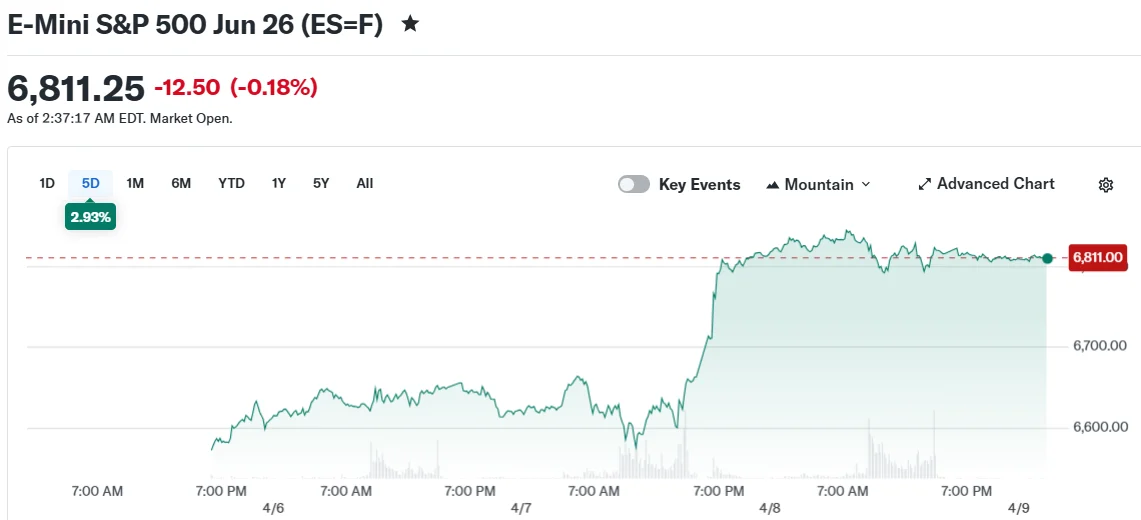
These losses came on the heels of Wednesday’s powerful rally during regular trading hours. The S&P 500 surged 2.5%, the Nasdaq advanced 2.8%, and the Dow Jones soared more than 1,300 points in its strongest single-session performance since April 2025.
European equity futures and the MSCI Asia Pacific Index similarly pointed toward lower openings Thursday. The Asian benchmark declined 0.9% after recording its most substantial single-day advance in a year during Wednesday’s session.
Treasury markets remained relatively stable after an earlier rally dissipated on concerns that elevated oil prices could reignite inflationary pressures.
The Federal Reserve continues to emphasize upside inflation risks even as labor market conditions show signs of softening. Meanwhile, Japan’s wage growth has reached multi-decade peaks, intensifying expectations for additional interest rate increases from the Bank of Japan.
One market analyst characterized the current environment as “uncoordinated tightening” across major global economies, introducing an additional dimension of uncertainty beyond the geopolitical tensions.
Investors are closely monitoring Thursday’s release of PCE inflation data and weekly jobless claims figures, both scheduled before the opening bell, for additional insight into the Federal Reserve’s potential policy trajectory.
