


Key Highlights
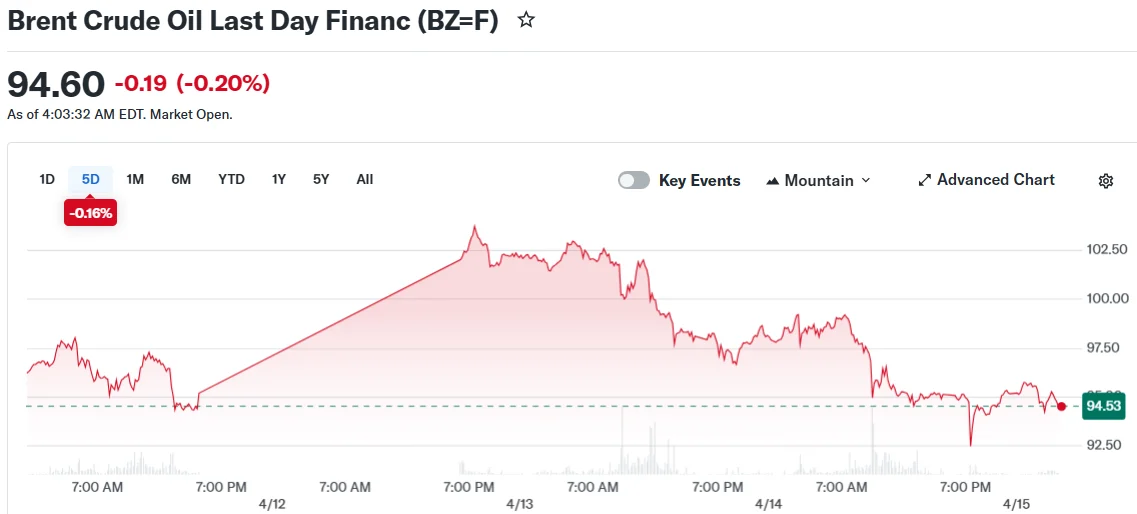
- Brent crude declined below $95 following Tuesday’s 4.6% plunge; WTI hovering around $91
- US Central Command confirms Iran naval cordon is now fully operational
- Trump indicates Iran conflict is “very close to over,” with additional negotiations anticipated in coming days
- Tehran reportedly weighing voluntary suspension of Hormuz shipments to prevent direct clash with US naval presence
- IEA and OPEC revise demand projections downward; Japan preparing emergency reserve releases in May
Crude oil markets have experienced dramatic volatility this week as market participants attempt to balance two conflicting developments: a fully operational US naval blockade surrounding Iran and mounting indications that diplomatic negotiations may soon resume.
Brent crude plummeted 4.6% during Tuesday’s session, falling beneath the $95 per barrel threshold. West Texas Intermediate dropped to approximately $91. Prices saw partial recovery during Wednesday’s Asian session following US Central Command’s confirmation that the blockade has reached full implementation.
Admiral Brad Cooper announced that US military forces have “completely halted economic trade going into and out of Iran by sea.” President Trump subsequently posted on social media, asserting the US had placed Iran in a “chokehold” and warning the nation could exhaust its storage infrastructure.
First full day of the U.S. naval blockade on Iran:
– Zero vessels left Iranian ports
– Six merchant ships turned back after American warnings
– No shots fired, no enforcement neededMeanwhile, traffic through the Strait of Hormuz continued normally with over 20 vessels passing… https://t.co/6PddzTyrPr pic.twitter.com/GavqZOarmX
— Mario Nawfal (@MarioNawfal) April 14, 2026
The blockade implementation occurred merely two days following ceasefire discussions in Pakistan that concluded without reaching an agreement. Washington is currently working expeditiously to arrange a second negotiating session before the existing ceasefire arrangement lapses next week.
Trump revealed to the New York Post that new discussions could commence “over the next two days.” He also informed Fox Business anchor Maria Bartiromo that he viewed the conflict as “very close to over.”
One possibility under consideration involves returning to Pakistan for subsequent negotiations, though alternative venues are being evaluated.
Tehran, meanwhile, is reportedly contemplating a voluntary halt to shipments traversing the Strait of Hormuz to circumvent a direct confrontation with the US naval blockade, according to a source with knowledge of the deliberations.
Asian Markets Face Severe Supply Constraints
The Strait of Hormuz facilitates approximately 20% of global oil supply. Since hostilities commenced in late February, Iran has obstructed virtually all maritime traffic through the strategic waterway.
ANZ analysts calculated that no less than 10 million barrels per day of supply has been eliminated due to the conflict. They observed that even absent a worst-case scenario escalation, supply tightness alone remains sufficient to maintain elevated Brent pricing.
Japan is making preparations to release a second tranche of national petroleum reserves beginning in early May. Refineries throughout the Asia-Pacific region may additionally face operational curtailments, diminishing availability of jet fuel and diesel products.
Both the International Energy Agency and OPEC have reduced their oil demand projections, attributing the revision to elevated prices constraining consumer purchasing power.
Market Analyst Perspectives
Dilin Wu at Pepperstone Group projected oil is likely to trade sideways with a “softer bias” in the immediate term as markets digest the pivot toward diplomatic engagement. He emphasized that even should tensions diminish, physical supply restoration will lag due to logistical constraints in the Hormuz vicinity.
ANZ indicated that if escalation risks dissipate, Middle Eastern supply could experience a phased recovery, with 2 to 3 million barrels per day restored during the initial four-week period.
Rebecca Babin, senior energy trader at CIBC Private Wealth Group, stated markets are “leaning toward a normalization of flows by the end of April.”
The American Petroleum Institute documented US crude stockpiles increased by 6.1 million barrels last week, which would represent the eighth consecutive weekly accumulation if validated by official government data released Wednesday.
The Trump administration has also confirmed it will permit a waiver authorizing limited Iranian crude purchases to lapse this weekend.
